If you’re comparing Direct Lit vs Edge Lit vs Full Array, the real question is simple: which TV backlight actually gives you the best picture for the way you watch TV? When I started comparing TVs more seriously for my own setup, I realized brands love throwing around terms like edge lit, direct lit, and full array without explaining what you’ll actually notice on screen.
Since I run whatismyscreenresolution.site, I spend a lot of time breaking down display specs into plain English, and TV backlights are one of those areas where the marketing can be more confusing than helpful. In simple terms, the backlight layout affects how deep blacks look, how much blooming you see in dark scenes, and whether HDR actually feels impressive.
If you’re trying to decide between a budget LED TV and something better for movies or gaming, this is the part that matters more than most shoppers realize. I’ll keep this practical and focus on what changes in real use, not just what sounds good on a spec sheet.
Also Read: 1ms MPRT Explained for Gamers
Quick Answer: Direct Lit vs Edge Lit vs Full Array
Full Array (especially with local dimming) is usually the best LED TV backlight for picture quality. It delivers better contrast, deeper blacks, and cleaner HDR highlights. Edge Lit is thinner and often cheaper, while Direct Lit is more budget-friendly but usually weaker for dark-room movie watching.
Understanding the Basics of LED Backlighting
Before we get to the three types, let’s cover the simple idea behind them. Modern LCD TVs don’t make light on their own. They use a separate light source that shines through the LCD panel to produce the image you see. That light source is usually made from LEDs arranged behind or along the edges of the screen. How those LEDs are arranged and controlled determines how well the TV can show deep blacks, bright highlights, and contrast in HDR scenes.
Older LCD TVs often used cold cathode fluorescent lamp (CCFL) backlights before LED systems became standard. That older approach worked, but LED backlights are thinner, brighter, and much easier to control for local dimming.
Local dimming is the feature that matters most here. It’s the TV’s ability to dim or brighten separate areas of the backlight independently. When local dimming works well, dark areas of the picture go very dark while bright areas remain bright, which improves contrast and makes images pop. The number of dimming zones, how quickly they react, and how smartly the TV’s software controls them all shape real-world performance.
Direct Lit Technology
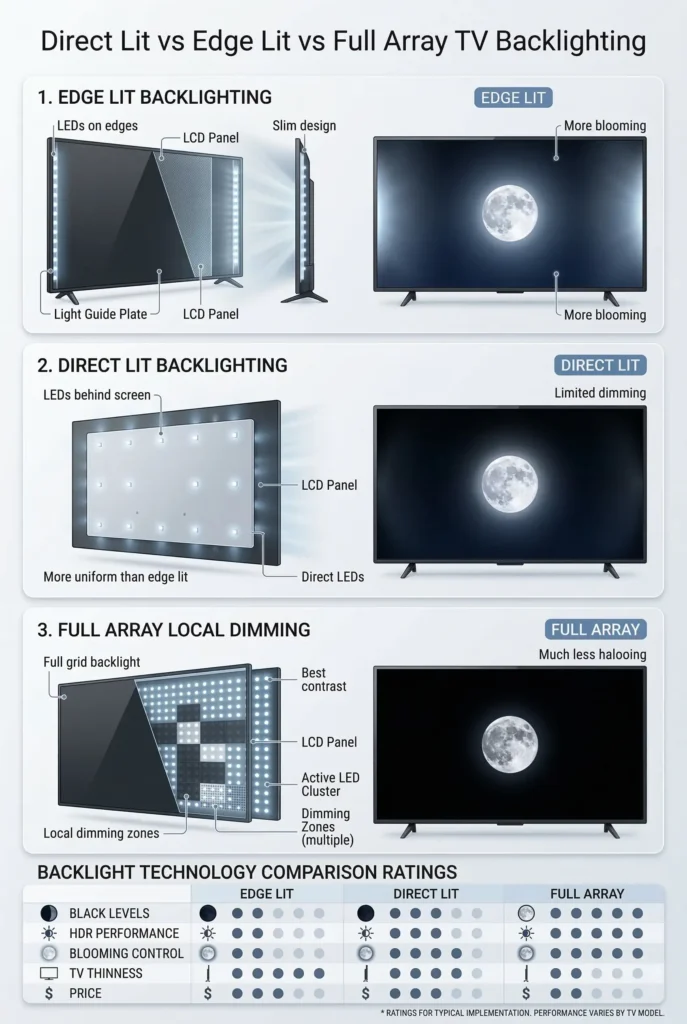
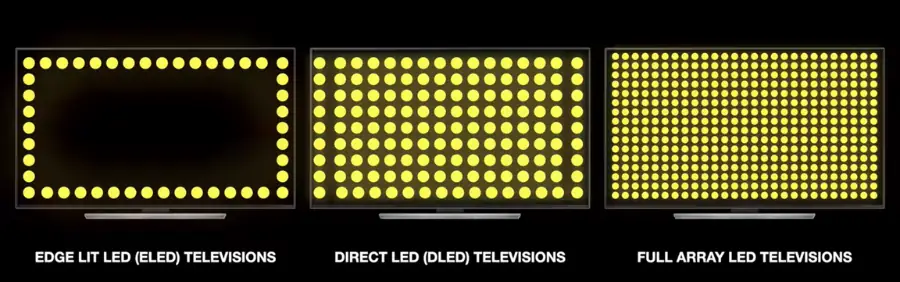
Direct Lit TVs have LEDs placed in a grid directly behind the LCD panel. Think of lots of small bulbs sprinkled across the back of the TV, lighting the screen from within. Many budget TVs use this layout because it is simpler and cheaper to build than more advanced solutions.
How it looks in real life: Direct Lit can produce more even illumination compared with the basic edge-lit approach, because the light is coming from behind the whole panel rather than only from the edges. But plain direct-lit sets usually have fewer LEDs and very limited local dimming capability. That means blacks can look more like dark gray, and bright highlights may wash out nearby dark areas.
Why some people like it: It is usually affordable and reliable. If you’re watching normal TV during the day in a bright room, a direct-lit TV can look perfectly fine. But if you want cinema-level contrast, it may fall short.
How to spot it when shopping: Advertised as “direct LED” or simply “LED backlight” in spec sheets. Don’t expect many local dimming zones unless the TV explicitly says “full-array local dimming” or specifies the number of zones.
Technical trade-offs: Direct-lit designs do not need a complex light guide plate that edge-lit TVs rely on, so in some thicker TV models they deliver consistent illumination. However, unless the manufacturer adds substantial local dimming zones, contrast remains limited.
Edge Lit Technology
Edge Lit puts LEDs around the perimeter — typically along the top and bottom or just the sides — and then uses a light guide to spread that light across the screen. Because the LEDs are only at the edges, edge-lit TVs can be made very thin and light. That is the main reason TV makers use this design in slim models.
Real-world picture characteristics: Edge-lit TVs tend to be bright and thin, but controlling light precisely in the center of the screen is harder. When a bright object appears against a dark background, edge-lit sets can create a halo or “blooming” effect, because the whole edge lighting system sometimes brightens a larger portion of the screen than necessary. On cheaper models, that can also show up as light bleed near the corners or edges during dark scenes.
Where edge-lit works: In bright rooms or when you want a sleek, wall-hugging TV without thick backs, edge-lit is a popular choice. Mid-range models with some form of zone dimming can also do an okay job with HDR.
Common pitfalls: Cheaper edge-lit sets either do not have local dimming at all or have very crude dimming that makes blacks look muddy or causes uneven brightness across the screen. Still, better edge-lit TVs with more advanced local dimming algorithms can perform respectably for most viewers.
Full Array Technology (FALD)
Full Array means lots of LEDs spread evenly across the entire back of the screen. When paired with local dimming and a decent number of zones, this setup is often called Full Array Local Dimming, or FALD. This design gives the best control of brightness and darkness because the TV can dim small portions of the backlight independently.
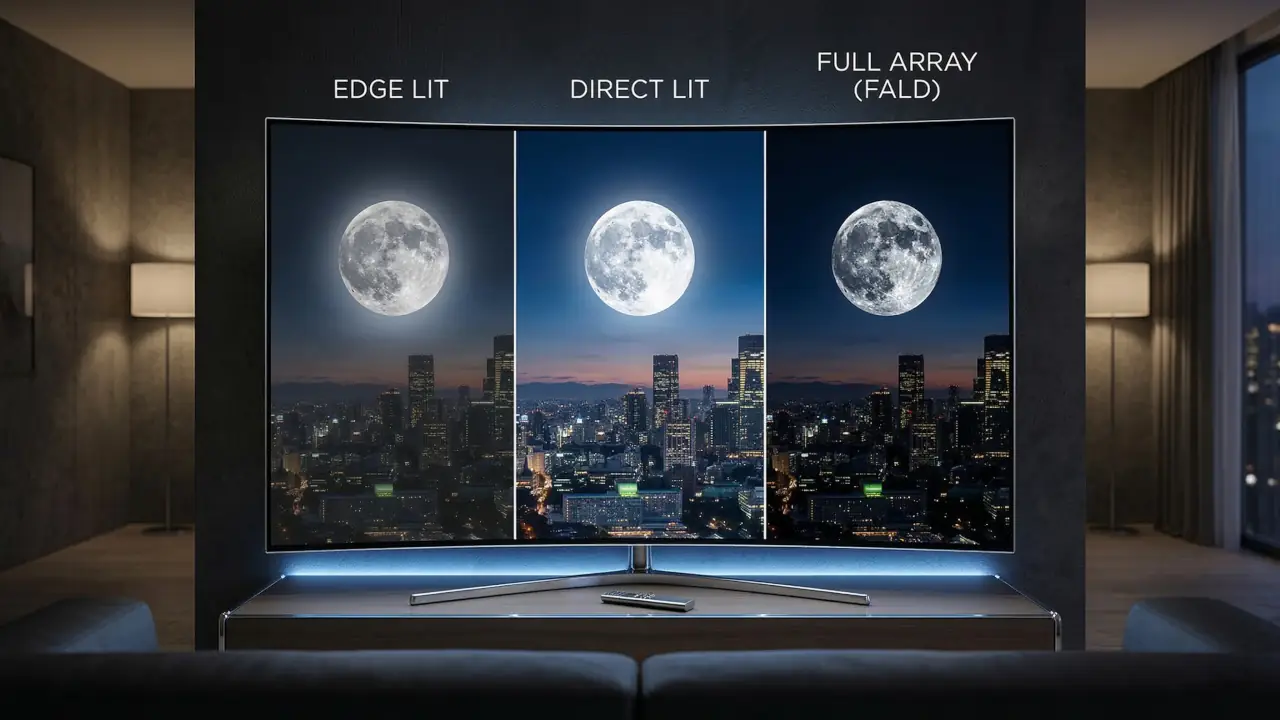
Real-world results: When a bright moon appears in a night scene, a FALD TV can keep the moon bright while dimming the surrounding sky to near-black. That’s how you get deep contrast and minimal haloing. The more dimming zones, the finer the control, and the better the picture for HDR content.
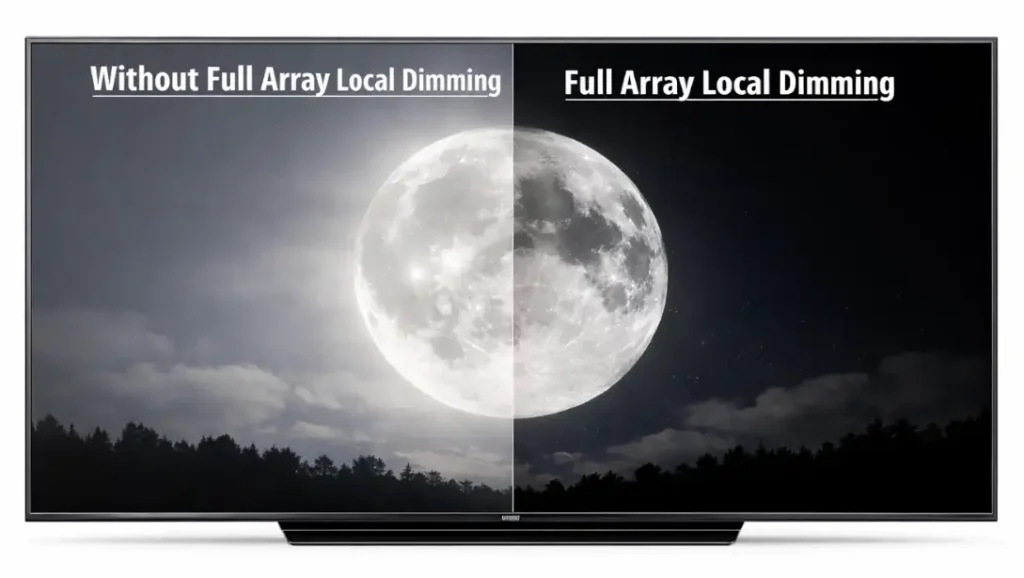
Cost and complexity: Full array sets are usually thicker and more expensive because they require more LEDs, more complex electronics, and better algorithms to prevent obvious transitions between zones. High-end models with many zones can approach OLED-like blacks in certain scenes, but they still can show some blooming around small, very bright objects because the backlight zones are larger than individual pixels.
Why Full Array is often called the best compromise: It blends the high brightness of LED/LCD systems with much improved local contrast. For viewers who prioritize HDR movies and deep contrast in a dim room, full array is usually the better choice.
Direct Lit vs Full Array: What’s the Real Difference?
The biggest real-world difference between Direct Lit and Full Array is local dimming. Both place LEDs behind the screen, but basic direct-lit TVs usually have fewer LEDs and little or no precise dimming control. Full Array TVs use more LEDs and multiple dimming zones, so they can keep bright highlights bright while dark parts of the image stay much darker. In practical terms, that usually means better contrast, stronger HDR, and a more cinematic picture.
Comparison: Direct Lit vs Edge Lit vs Full Array
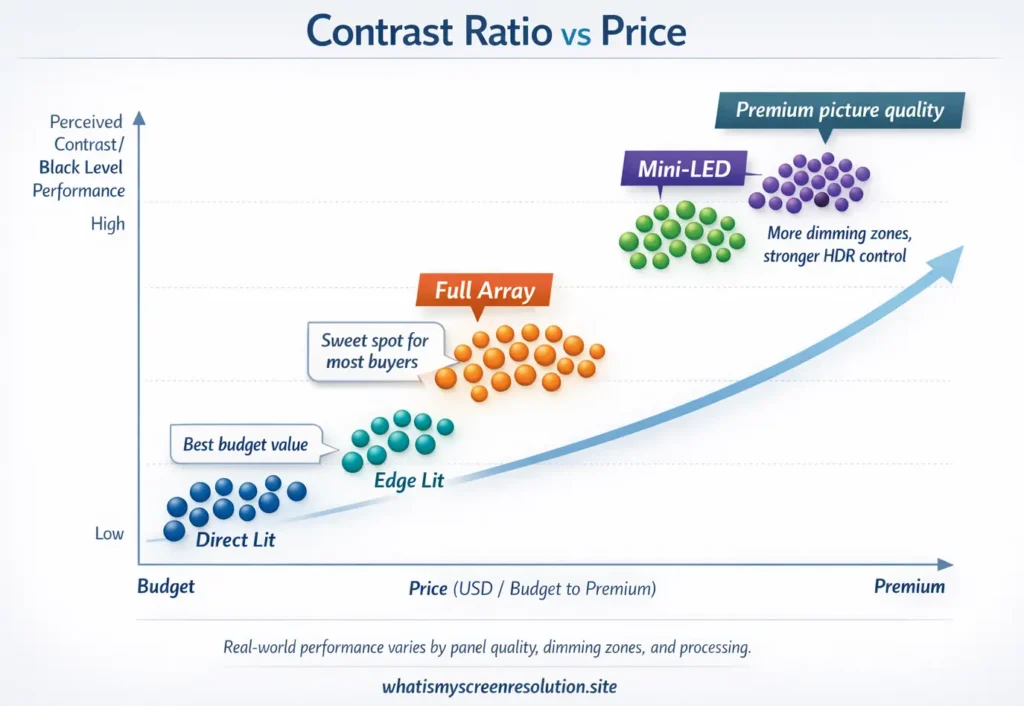
Here’s the simplest way to compare Direct Lit vs Edge Lit vs Full Array in real buying terms: black levels, HDR performance, blooming risk, TV thickness, and price.
| Backlight Type | Black Levels | HDR Performance | Local Dimming | Blooming Risk | TV Thickness | Typical Price | Best For |
| Direct Lit | Fair | Basic to moderate | Rare or very limited | Moderate | Medium | Low | Budget buyers, daytime TV |
| Edge Lit | Fair to good (depends on dimming) | Moderate | Limited, often broad zones | Higher | Thin | Low to mid | Bright rooms, slim wall-mounted TVs |
| Full Array (FALD) | Good to excellent | Strong | Yes, multiple zones | Lower (but not zero) | Thicker | Mid to high | Movies, HDR, dark-room viewing |
| Mini-LED | Excellent for LCD | Excellent | Yes, many more zones | Low | Medium to thick | High | Premium HDR, gaming, bright + dark room versatility |
| OLED | Best | Excellent (scene-dependent brightness) | Pixel-level light control (not backlight dimming) | None | Thin | Mid to premium | Best blacks, cinematic dark-room viewing |
If you care about deep blacks and watching HDR movies in a dark room, full array with a decent number of dimming zones is the clear pick. It keeps bright and dark parts of the image separated more cleanly, so the content looks closer to what the director intended. If you mostly watch in a bright living room and prefer a very thin TV that looks neat on the wall, edge lit is tempting because of its slim profile and often lower weight. Direct lit is the budget choice: solid for daytime TV and casual use, but not the best for demanding movie nights.
There are also practical behaviors to watch for. Blooming shows up more on edge-lit and on some full-array sets with too-few zones. Dirty screen effect, where cloud-like patterns appear on uniform bright backgrounds, is more a panel and diffuser issue than pure backlight topology, but the way light is distributed (edge vs full) can make it more or less visible.
For gamers, response time and input lag matter more than backlight type, though the ability to produce bright HDR highlights without washing blacks is still important for HDR-enabled games. If you game in a bright room, a bright edge-lit or full-array TV can work well; for late-night single-player immersion, full array usually looks better.
In practice, local dimming usually improves contrast, and more dimming zones generally help, but the implementation matters as much as the raw zone count. I’ve seen TVs with similar specs behave very differently depending on how aggressively the manufacturer tunes blooming control, black crush, and HDR brightness.
How to Spot TV Marketing That Hides the Backlight Type
One thing I always watch for: some brands advertise a TV as simply “LED” or “Direct LED” without clearly telling you whether it has meaningful local dimming. If the product page doesn’t mention dimming zones, full-array local dimming, or Mini-LED, assume the backlight is basic until proven otherwise.
Other Technologies to Know
You’ll hear new terms in every TV ad. Here’s a friendly translation.
Mini-LED
This is still an LED-backlit LCD, but with thousands of much smaller LEDs. Because the LEDs are tiny, manufacturers can pack in many more local dimming zones. That drastically reduces blooming and yields much better contrast for LCDs. Mini-LED TVs can reach very high sustained brightness and avoid burn-in issues that some other technologies face. But they are more expensive and more complex to manufacture. In practical terms, Mini-LED is basically a more advanced version of full-array local dimming with much finer control.
OLED
OLED panels are self-emissive. Each pixel creates its own light, so when a pixel should be black, it is literally off. That gives perfect blacks and superb viewing angles and removes any bloom you’d see with LED backlights. Because of that, OLED is famous for cinematic image quality in dark rooms. If you want a deep, uniform black without local dimming tricks, OLED is a great choice. If you want a broader look at how HDR changes the requirements for backlights, that comparison is worth reading next—especially if you’re deciding between a bright Mini-LED TV and an OLED for movies or gaming.
QLED
A marketing term that usually means an LCD TV with a quantum dot layer to improve color and brightness. QLED TVs still use LED backlights—edge lit, direct lit, or full array—so the backlight type still determines black levels and blooming performance. In other words, QLED can improve brightness and color, but it does not automatically mean better blacks.
MicroLED and Micro-LED
These are emerging technologies where each tiny LED is the pixel itself, similar to OLED in being self-emissive, but using inorganic LEDs that promise very high brightness and long life. They are not common in consumer TVs yet because they are expensive.
Real-World Example: What You’ll Notice in a Dark Movie Scene
Here’s the easiest way I explain it. Imagine you’re watching a night scene with a bright moon in the sky. On a cheaper edge-lit TV, the moon may look bright, but the surrounding sky can look gray or slightly washed out because the TV can’t control the light precisely enough. On a basic direct-lit model, you may get slightly better overall uniformity, but dark areas still won’t look truly deep. On a good full-array local dimming TV, the moon stays bright while the sky stays much darker, so the image looks more cinematic and less flat. That’s the kind of difference people usually notice immediately when they compare TVs side by side in a dim room.
Practical Buying Advice
If you watch mostly daytime TV in a bright family room and you want a thin, affordable set, choose a mid-range edge-lit model with good peak brightness and decent color accuracy. Look for reviews that test local dimming performance and uniformity.
If you watch movies in a dim room and care about deep blacks, go full array with a healthy number of dimming zones, or consider OLED if you want true pixel-level blacks and exceptional viewing angles.
If you want top-end HDR brightness and minimal blooming but are willing to spend more, look at Mini-LED sets. They can beat traditional full-array backlights in sustained HDR scenes because they offer many more, much smaller zones.
If gaming is your priority, check input lag and VRR performance first, but do not ignore backlight. For HDR gaming, a full-array or Mini-LED set often offers a better picture than a similarly priced edge-lit TV.
If you’re choosing between a 55-inch and 65-inch TV and want to know how much wall space each one actually uses, you can also use my tool to convert diagonal size to width and height before you buy.
Always check real-world reviews from labs that measure contrast, black level, haloing, and peak brightness — numbers tell you more than spec marketing. Expert reviews that perform side-by-side tests will give you the practical comparisons you need.
Also Read: HDR Tone Mapping on TVs: The Hidden Feature That Can Make or Break HDR
Conclusion
Backlight type matters more than most TV spec sheets make it seem. If you want the clearest winner in Direct Lit vs Edge Lit vs Full Array, Full Array is usually the best all-around choice for picture quality among standard LED TVs. If you want the deepest blacks overall, OLED still wins. If you need a slimmer TV for a bright room and want to spend less, edge-lit models can still make sense. Direct-lit remains the practical budget option for casual daytime watching.
If I had to simplify it: For standard LED/LCD TVs, Full Array is the best all-around backlight type for most people who care about picture quality, especially for movies, HDR, and evening viewing. Edge Lit is fine if your room is bright and you want a slimmer, cheaper TV, and Direct Lit still makes sense when budget matters more than black-level performance. If you can stretch further, Mini-LED is where LCD TVs start looking seriously impressive. I’d still trust measured reviews over marketing terms every time, because two TVs with similar labels can perform very differently once you look at blooming, black uniformity, and real HDR behavior.