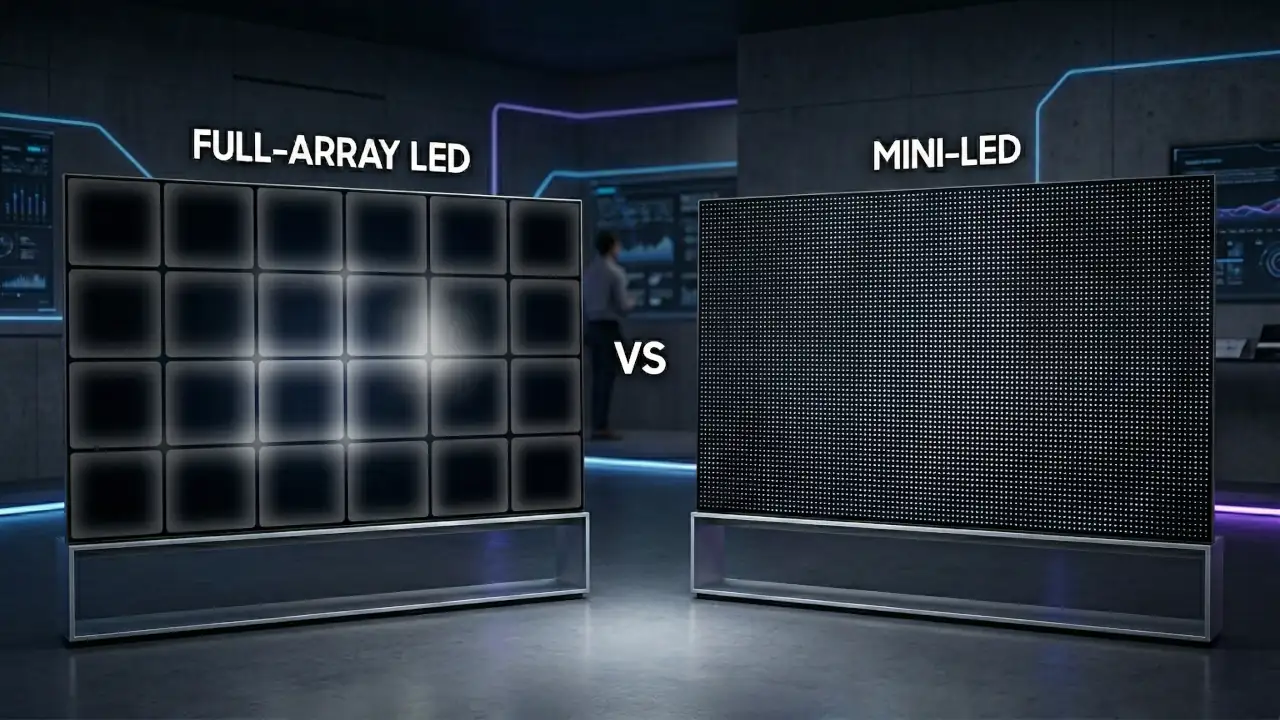
I’ve tested enough TVs, display specs, and screen-related tools to know that TV marketing can make a simple buying decision feel way more complicated than it needs to be. Terms like Full Array LED, Mini-LED, local dimming, and HDR sound impressive on a product page, but when you’re actually shopping, the real question is much simpler: which one looks better in your room when you sit down and watch something?
In most cases, Mini-LED has the edge because it uses smaller, denser backlights and more dimming zones, which usually means better brightness control, less blooming, and stronger HDR performance. That said, Full Array LED with local dimming is still a very good option, especially if you want strong contrast without paying for a more premium Mini-LED set.
One reason I built whatismyscreenresolution.site was to make display tech easier to understand without burying people in jargon. A lot of readers come in trying to check screen resolution or compare display specs, then realize picture quality depends on more than just resolution. Backlight design matters too, especially when you’re trying to figure out why two TVs with the same 4K label can look very different in real life.
If your room is bright, you care about punchy HDR highlights, or you watch a lot of sports and streaming during the day, Mini-LED is usually the better buy. If you want better value and still want a noticeable step up over basic LED TVs, a good Full Array LED set can still be the smarter choice. Here’s the practical difference in plain English.
Also Read: HDR Tone Mapping on TVs: The Hidden Feature That Can Make or Break HDR
If you just want the short version before we break it down, here it is:
Quick Answer: Full Array LED vs Mini-LED
Mini-LED is usually better than Full Array LED because it uses smaller, denser LEDs with more local dimming zones, which improves brightness, contrast control, and blooming reduction. Full Array LED (FALD) is still an excellent value option and can deliver very strong picture quality for less money.
If you search for Mini-LED vs FALD, the practical difference is usually this: Mini-LED gives you tighter light control, while FALD is often the better value buy.
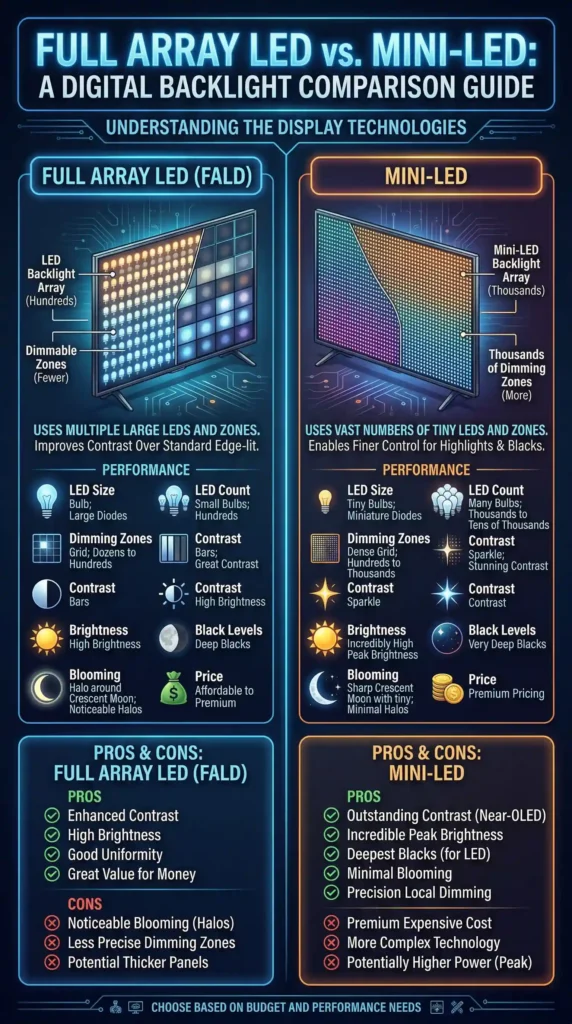
Here’s the quick visual breakdown before we get into the details:
Understanding LED Backlighting Basics
Before comparing the two, it helps to understand what the backlight is doing in the first place. LCD panels do not make their own light. They work like shutters that control how much light passes through each pixel, so they need a separate light source behind them. Modern LED TVs use that light source in a few different ways, including the familiar edge-lit and direct-lit designs. Edge-lit sets place LEDs around the border, while direct-lit and full-array designs place LEDs behind the screen itself, which usually gives the TV more control over brightness and contrast.
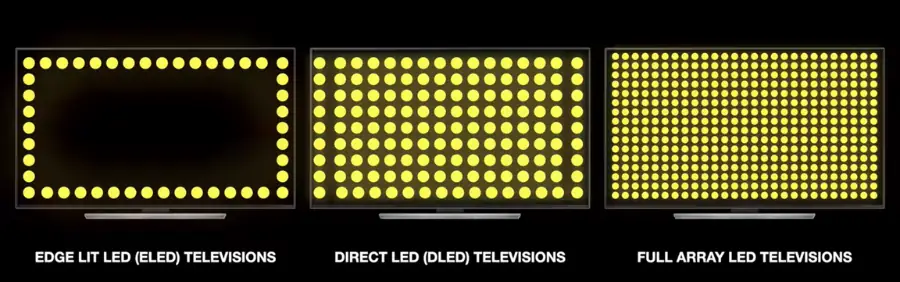
That difference matters because the backlight is what creates the TV’s brightness, shadow detail, and uniformity. A better backlight does not magically turn an LCD into OLED, but it can make dark scenes look cleaner, bright scenes look stronger, and halos around bright objects much less distracting. That is why the backlight type is such a big deal when people compare TVs, especially for movies and HDR viewing.
Full Array Local Dimming (FALD) LED Explained
Full Array LED usually means the LEDs sit across the whole back of the panel instead of just along the edge. When that setup includes local dimming, it becomes Full Array Local Dimming, or FALD. The basic idea is simple: the TV can dim dark parts of the image while keeping bright parts bright, zone by zone. That gives you deeper blacks, better contrast, and more control than edge-lit designs. Sony’s Full Array LED explanation aligns with that basic idea: LEDs are placed behind the screen for more precise brightness and contrast control than simpler edge-lit designs.
In practice, FALD is a big reason many LED TVs look much better than people expect. A good FALD screen can make night scenes feel richer, reduce the washed-out look that cheaper TVs often have, and improve shadow detail without sacrificing too much brightness. The trade-off is that blooming can still happen, especially around subtitles, stars, and bright logos on dark backgrounds, because each dimming zone still covers a group of pixels rather than a single pixel. More zones help, but the technology is still working at the zone level, not the pixel level.
Mini-LED Technology Unveiled
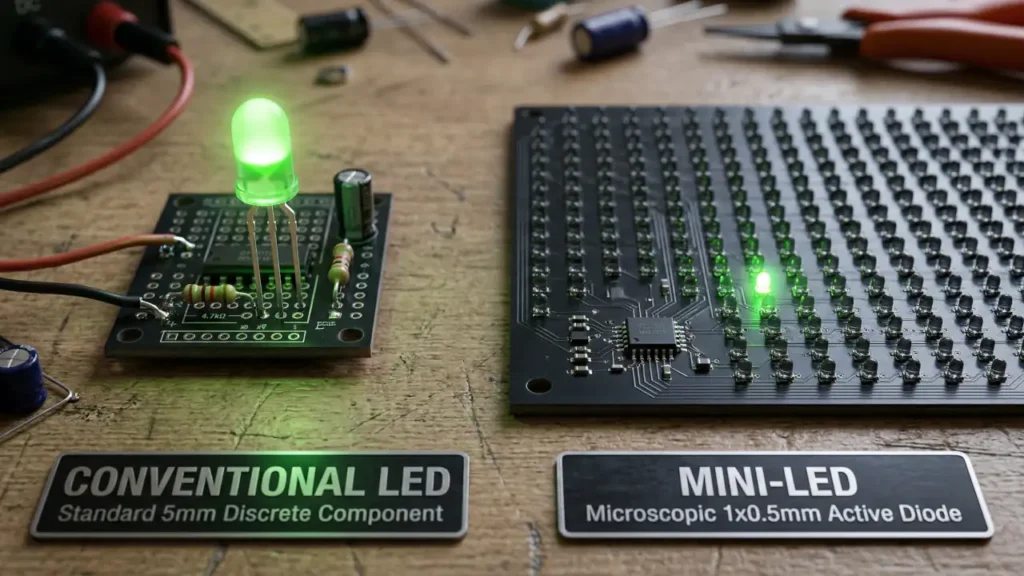
Mini-LED is basically the next step in the same LCD backlight story. Instead of using larger LEDs, it uses much smaller and denser LEDs, which lets the TV pack in far more lighting control zones behind the panel. That is the whole appeal: more precision, better control over bright and dark areas on the same screen, and usually stronger contrast than a standard full-array setup.
In practice, traditional Full Array LED TVs often work with dozens to a few hundred dimming zones, while Mini-LED models can scale much higher depending on the TV, which is one reason their light control usually looks more refined.
This is also where OLED enters the conversation, because Mini-LED often gets compared with OLED even though it is still an LCD-based system. OLED is different because each pixel produces its own light and does not need a backlight at all. LG’s OLED technology explanation makes that distinction clear, and it’s the reason OLED can produce true black by turning individual pixels off completely, while Mini-LED and FALD still rely on zone-based backlight control.
So what does Mini-LED actually improve? Mainly two things: it gives the TV more chances to keep bright highlights bright and dark areas dark at the same time, and it reduces blooming because the zones are smaller and more numerous. That is why Mini-LED often looks more refined than standard FALD, especially in scenes with stars, candlelight, menus, or subtitles.
Full Array LED vs Mini-LED at a Glance
| Feature | Full Array LED (FALD) | Mini-LED |
| Backlight design | LEDs spread behind the panel | Much smaller, denser LEDs behind the panel |
| Local dimming precision | Good | Better |
| Blooming control | Good, but visible on harder scenes | Usually better and less distracting |
| Peak brightness | Good to very good | Very good to excellent |
| Dark-room movie performance | Strong | Usually stronger |
| Bright-room HDR performance | Good | Usually better |
| Price | More affordable | Usually more expensive |
| Best for | Value-focused buyers | Premium LCD buyers |
Side-by-Side Comparison: FALD vs. Mini-LED
If you care most about contrast and dark-room movie watching, both technologies can do a good job, but Mini-LED usually has the edge because its smaller LEDs and higher zone counts let it control light more precisely. FALD can still look excellent, especially in better mid-range and upper-mid-range TVs, but Mini-LED typically reduces the halo effect a little more and preserves bright detail more cleanly. That is the practical difference most people notice first.
Brightness is another place where Mini-LED often wins. Because the backlight can be packed more densely and controlled more finely, premium Mini-LED TVs commonly reach very strong peak brightness, which helps in sunlit rooms and makes HDR highlights pop. FALD can still get bright, but Mini-LED is usually the more aggressive performer when manufacturers want a flagship LCD to stand out in a showroom.
That is one reason premium TV lines keep leaning toward Mini-LED. Uniformity is a little more nuanced, though. A good FALD TV can look very even across the screen, and on some content the difference from Mini-LED may be subtle. But when you start looking at fine detail in dark scenes, Mini-LED tends to hold up better because it can split the backlight into smaller regions. The result is usually less light spill, less flare, and fewer visible lighting artifacts around high-contrast objects.
Cost usually tilts the other way. FALD is often the more affordable way to get real local dimming and a meaningful contrast boost, while Mini-LED tends to live in the premium tier. That does not mean FALD is “cheap” or “bad.” It means FALD is still a very smart value choice if you want stronger picture quality without paying for the latest zone-heavy backlight design. That value gap is one of the reasons both technologies still matter.
Which One Should You Buy?
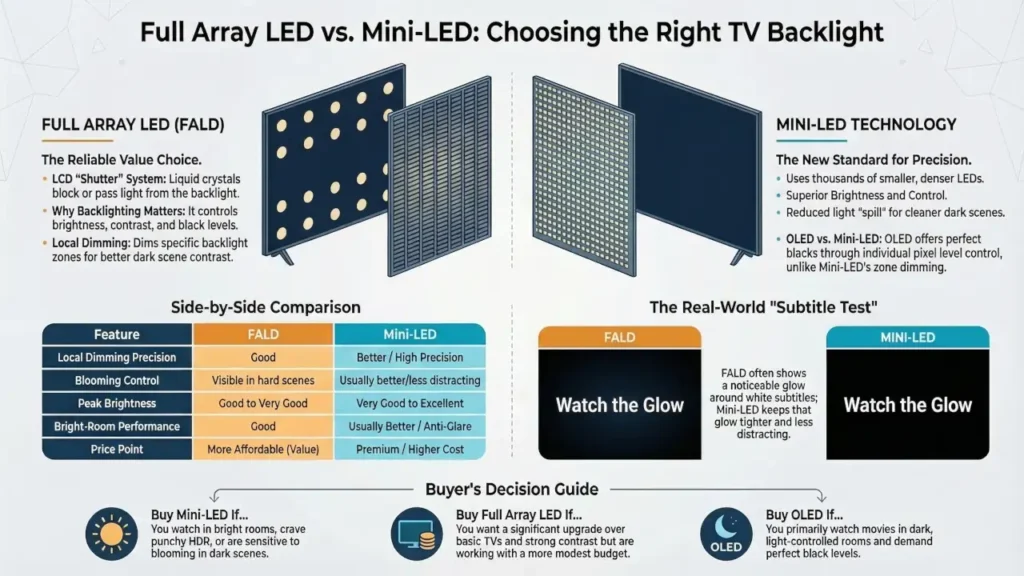
If you want the quick buying recommendation visually, this is the simplest way to look at it:
Real-World Performance: FALD vs. Mini-LED
For bright living rooms, Mini-LED is usually the better all-rounder. Its stronger brightness and tighter zone control help it fight glare and keep HDR content visible when sunlight hits the screen. If you watch a lot of live sports, streaming movies, or console games in a room with lamps or daylight, Mini-LED is often worth the upgrade because the image keeps its punch instead of looking flat.
Real-World Example: Subtitles in a Dark Scene
One of the easiest ways I compare FALD and Mini-LED in real life is by watching a dark movie scene with bright subtitles turned on. On weaker Full Array LED sets, you can sometimes see a noticeable glow around the subtitle area because the dimming zone is larger. On a better Mini-LED TV, that glow is usually tighter and less distracting. It’s not the same as OLED-level black, but it’s one of the clearest real-world differences most buyers can actually spot without needing test patterns.
For mixed use and budget-conscious buyers, FALD is still very appealing. It can give you a noticeable jump over edge-lit TVs without forcing you into the highest price bracket. If you mostly watch regular TV, YouTube, cable sports, or standard streaming in a room that is not overly bright, a good FALD set can feel like the sweet spot. You still get local dimming, deeper blacks, and better contrast than simpler LCD designs.
For HDR movies and games, the backlight matters a lot. HDR looks best when the screen can get bright, keep shadows under control, and avoid muddy highlights. That is why strong local dimming is such a selling point. In your own site’s HDR guide, the core point is the same: HDR only looks great when the display has the hardware to support it. Mini-LED is usually better at that hardware job, but FALD can still deliver a very satisfying HDR experience if the TV is good enough.
If you are comparing these with OLED, the main takeaway is simple. OLED still wins on pixel-level black levels because it does not need a backlight at all, but Mini-LED often wins on pure brightness and can be the better choice for bright rooms. That is why the decision is less about “which is best overall” and more about “which is best for your room and habits.”
Also Read: Local Dimming: Is This TV Feature Worth Paying Extra For?
Future Trends
Based on the 2026 TV launches I’ve been tracking, the trend is pretty clear: manufacturers are trying to make LCD TVs behave more like self-emissive displays by increasing dimming zones, tightening backlight control, and pushing Mini-LED into more premium product lines. We’re also seeing RGB Mini-LED concepts show up more often, which could further improve color control and reduce some of the usual LCD compromises. At the same time, OLED keeps getting brighter too, so the competition is only getting tougher. For buyers, that’s a good thing because every generation is squeezing more performance out of these display technologies.
My honest read is that FALD will stay relevant as the value option, while Mini-LED keeps creeping downward into more price tiers as production gets better. That is an inference based on the current product direction, not a guaranteed rule, but it matches how TV makers have been positioning these technologies. In other words, FALD is not going away, but Mini-LED is becoming the backlight people expect in better LCD TVs.
Conclusion
If you want the cleanest possible answer, here it is: Mini-LED is usually better than Full Array LED when you care most about brightness, blooming control, and premium HDR performance. Full Array LED with local dimming is still a strong choice when you want noticeably better contrast than edge-lit TVs without paying for a more premium Mini-LED model. The right pick depends on your room, your budget, and how sensitive you are to blooming in darker scenes.
For most people, the practical decision is simple: choose Mini-LED if you want the best LCD performance in a bright room, choose FALD if you want the better value buy, and choose OLED if your top priority is perfect blacks in a darker room.
If I were buying today for a bright living room, I’d personally lean Mini-LED because the extra brightness and tighter dimming are easier to appreciate day to day. But if I found a strong Full Array LED model at a good price, I’d still consider it a smart buy for mixed use, sports, and casual streaming. That’s really the takeaway: Full Array LED is still a strong option, but Mini-LED is usually the more refined version of the same basic LCD approach.