When I built whatismyscreenresolution.site, one thing I noticed quickly was that many people understand resolution numbers like 1080p or 4K, but they still are not sure why two screens with the same resolution can look completely different. That usually comes down to panel technology, and OLED technology is one of the biggest reasons a display can look dramatically better even when the pixel count stays the same.
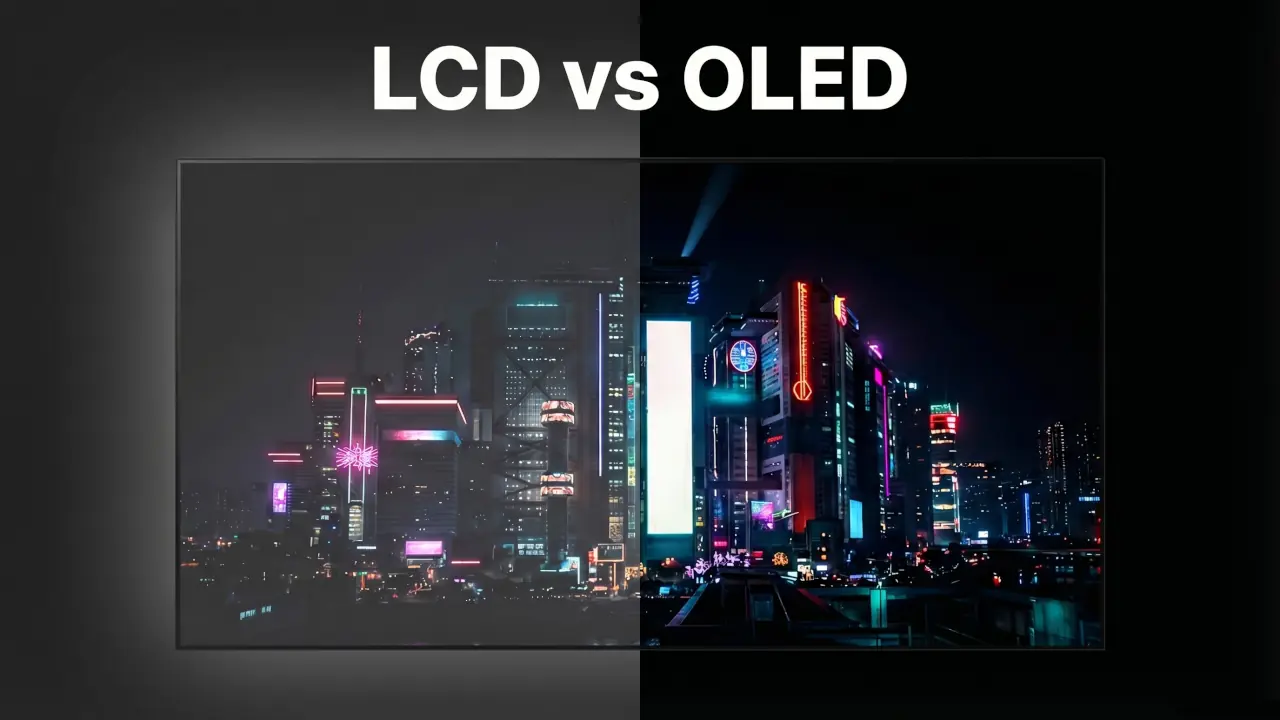
I have compared OLED phones, OLED laptops, and OLED TVs side by side with LCD and LED-backlit panels while testing screen clarity, black levels, and general image feel. The difference is usually obvious the moment a dark scene appears. OLED screens tend to look deeper, cleaner, and more “alive,” especially when you are viewing HDR content, gaming, or using a device in a dim room.
In this guide, I’ll explain OLED in plain English without the usual marketing fluff. I’ll cover what OLED is, how it works, why it looks better, the difference between AMOLED and PMOLED, how OLED panels are made, and where the technology is heading next. If you have ever wondered why one display feels premium even at the same resolution, this is the piece that will make it click.
Also Read: Full Array LED vs OLED: Which TV Display Is Actually Better?
Quick Answer: What Is OLED Technology?
OLED (Organic Light Emitting Diode) is a display technology where each pixel creates its own light instead of relying on a backlight. That allows OLED screens to deliver true black levels, stronger contrast, faster response times, and thinner or flexible designs compared with traditional LCD-based displays.
If you are asking what is OLED in simple terms, it is a display technology where each pixel produces its own light instead of relying on a separate backlight.
What is OLED?
OLED stands for Organic Light Emitting Diode. That name sounds technical, but the idea is simple. An OLED is a display technology where organic compounds emit light when electricity passes through them. “Organic” in this case does not mean food-grade or eco-friendly. It refers to carbon-based materials used in the light-emitting layers of the panel.
The important part is this: OLED displays are emissive. As the U.S. Department of Energy explains, OLEDs are solid-state devices made from organic thin films that emit light when electricity is applied.
That means the pixels make their own light. They do not need a separate backlight like LCD panels do. Because of that, OLED screens can be thinner, lighter, and more flexible. They can also show true black by turning pixels completely off. That is one of the biggest reasons OLED picture quality stands out right away.
In everyday use, OLED is the reason dark scenes look richer, shadows hold detail better, and colors appear more vivid without looking fake. It is also why many high-end smartphones, premium TVs, and advanced wearable devices use OLED-based panels. The technology is already common in consumer electronics, but it is still developing quickly in areas like foldable phones, AR headsets, and stretchable displays.
How Does OLED Work?
If you are wondering how OLED works, the short answer is that OLED panels use thin organic layers between two electrodes, and those layers emit light when electricity passes through them. This process is called electroluminescence.
When I explain this to non-technical readers, I usually put it this way: OLED works because each pixel is doing its own job instead of waiting for a shared light source behind the screen. That is the single idea that makes the rest of OLED easier to understand.
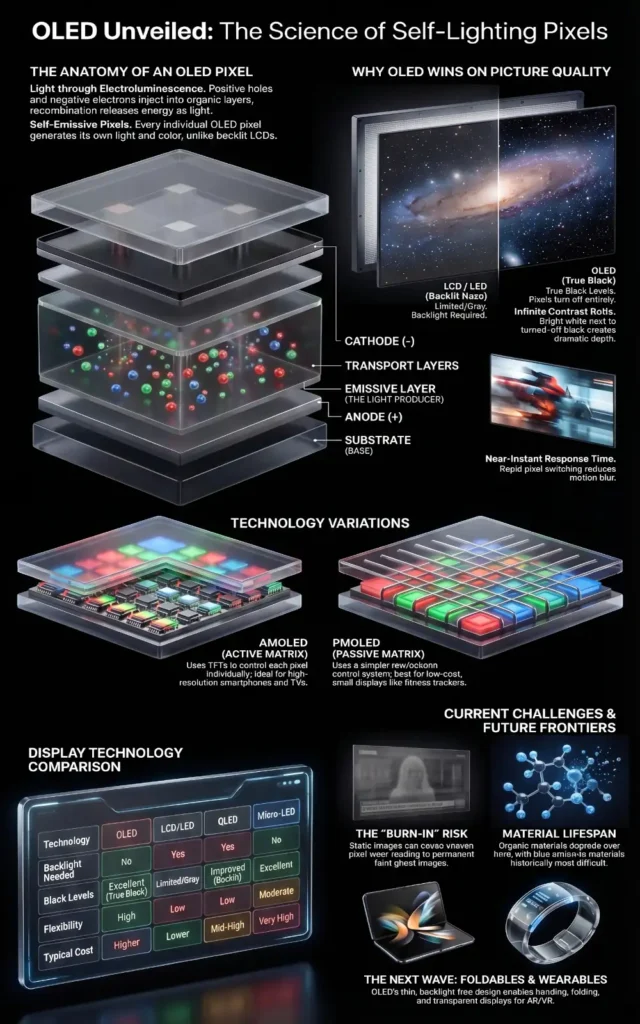
Here is the easy version. The anode injects holes, which are basically positive charge carriers. The cathode injects electrons. These meet inside the organic layers, usually in the emissive layer, and when they recombine, energy is released as light. Different organic materials emit different colors, which is why OLED pixels can produce red, green, and blue light to form full-color images.
Because each pixel is its own light source, the screen does not have to brighten the whole panel just to light up a small part of the image. That is one of the reasons OLED looks so good in dark scenes. If a part of the image should be black, the screen can simply turn those pixels off completely. With LCD, the backlight is still on, so the black areas often look more like dark gray.
There is another upside here too. Since OLED pixels switch on and off very fast, motion tends to look clean and responsive. That matters for gaming, scrolling, sports, and fast-moving video. The whole panel can feel more immediate because it is not waiting on a backlight to do the heavy lifting.
Basic OLED Layers Explained
If you want a slightly more technical view, a typical OLED panel is built from several thin layers that each do a specific job:
- Substrate: The base layer that supports the panel, often glass or flexible plastic.
- Anode: The positive electrode that helps inject holes into the organic layers.
- Cathode: The negative electrode that injects electrons.
- Emissive layer: The layer where light is actually produced when electrons and holes recombine.
- Transport layers: These help move charge efficiently to the emissive layer so the panel can produce light more effectively.
You do not need to memorize every layer to understand OLED. The important practical takeaway is that OLED is a stack of extremely thin materials designed to generate light directly at the pixel level instead of relying on a separate backlight.
Why OLED Picture Quality Feels So Different
OLED tends to stand out most in three areas. First, the contrast is excellent. Second, colors can look very rich without looking washed out. Third, the screen response is fast enough that motion blur is often reduced compared with many older display types.
This is also where wider color reproduction comes into the picture. A screen with good OLED implementation is often associated with a wide color gamut because it can display a larger range of colors more accurately. That matters a lot when you watch movies, edit photos, play games, or just want a display that looks more lifelike.
OLED also pairs beautifully with HDR. HDR is not only about making highlights brighter. It is also about preserving detail in shadows and expanding the range between the darkest and brightest parts of the image. OLED’s ability to turn individual pixels off gives HDR content a lot more room to breathe. That is why HDR on OLED often looks more dramatic and more natural at the same time.
When people say OLED looks “cinematic,” this is usually what they mean: deeper blacks, brighter highlights, and a stronger sense of depth without the gray haze that often shows up on backlit displays.
A simple real-world example: if you watch a movie with lots of dark scenes, like a space sequence or a night-time thriller, OLED usually makes stars, subtitles, and shadow detail stand out much more clearly than a typical LCD. I have seen this a lot when comparing the same streaming content across different displays. The resolution might be identical, but the OLED panel usually looks more immersive because the blacks are actually black instead of dark gray.
Types of OLED Displays: AMOLED vs PMOLED
When people compare AMOLED vs PMOLED, the biggest difference is how each display controls its pixels and how well it scales to larger, sharper screens. Not all OLED displays are driven the same way. The two names you will hear most often are AMOLED and PMOLED.
AMOLED
AMOLED stands for Active Matrix Organic Light Emitting Diode. In an AMOLED panel, each pixel is controlled by a thin-film transistor, or TFT, and usually a capacitor as part of the driving circuit. That gives the display precise control over each pixel’s brightness and timing.
This matters because it lets AMOLED panels scale well to larger, sharper, and more complex displays. It is the reason AMOLED is common in smartphones, premium tablets, smartwatches, laptops, and many OLED TVs. Active matrix driving also helps with lower power use in real-world content, because the panel can manage pixels more intelligently.
If you want the short practical takeaway, AMOLED is the version of OLED that most people encounter in modern consumer devices, especially where resolution, smooth animation, and good power behavior matter.
PMOLED
PMOLED stands for Passive Matrix Organic Light Emitting Diode. It uses a simpler row-and-column arrangement instead of individual active transistor control for every pixel. That makes the structure simpler and, in some cases, cheaper to produce.
The trade-off is that PMOLED is usually better suited for smaller displays and simpler graphics, like icons, text, or basic interface panels. As screen size and resolution rise, the passive matrix approach becomes harder to manage efficiently. That is why PMOLED is not the format you normally see in large TVs or advanced phones.
In plain language, PMOLED is simpler and often more limited, while AMOLED is more advanced and is the better fit for high-end displays and bigger screens.
Fabrication Methods for OLEDs
Making an OLED panel is not as simple as printing a screen and turning it on. The layers inside the panel are extremely thin and have to be built carefully. In practice, OLED fabrication methods are usually grouped into dry methods, wet methods, and a few other process families.
Dry Method
The dry method is typically associated with vacuum-based deposition techniques. A common example is vacuum thermal evaporation (VTE), which is one of the most established OLED manufacturing techniques used in premium display production.
In this process, organic materials are deposited in a controlled vacuum environment so the layers can be built with high precision. This approach is often used when high performance and fine image quality matter.
Dry methods are valued because they can produce excellent device quality and support very accurate layer control. That is part of the reason many premium OLED displays use vacuum deposition, especially in high-end production lines.
The downside is cost and complexity. Dry processing can be material intensive, energy intensive, and difficult to scale as cheaply as simpler methods. It is powerful, but not always the easiest way to make large panels at low cost.
Wet Method
Wet methods use solution-based processing instead of vacuum deposition. Think of it more like applying liquid-based material layers using techniques such as inkjet printing, coating, or other solution processes. The major appeal here is scalability and cost reduction.
Wet processing is attractive because it can support large-area manufacturing and, in some cases, roll-to-roll production. That makes it interesting for future displays, lighting panels, and flexible electronics. A wet process can also reduce waste compared with some dry approaches.
The challenge is that getting the same performance, uniformity, and efficiency as dry deposition is not always easy. Wet methods are promising, but the material science and process control have to be very precise to match the best premium panels.
Other Methods
There are also other fabrication approaches used in OLED manufacturing, including inkjet printing, laser patterning, and hybrid processes. The key takeaway is that OLED is not tied to one production method. Researchers and manufacturers keep experimenting with different ways to make panels cheaper, more scalable, and better suited to flexible displays and future large-area applications.
Advantages of OLED Technology
OLED has a lot going for it, but three advantages tend to matter most in real life: picture quality, efficiency, and flexibility.
Picture quality
This is the headline feature, and for good reason. OLED delivers excellent black levels because individual pixels can switch completely off. That creates contrast that is hard for many other display technologies to match. Dark scenes look deeper, stars in space scenes look more distinct, and letters on a black background often appear crisp and clean.
OLED also gives you vibrant color and better viewing angles. Since the pixels are self-emitting, the image often stays more consistent when you move off-center. For many people, the first OLED screen they see feels immediately more premium because the image has more depth and less gray haze.
This is also where wide color gamut becomes important again. OLED panels are often chosen for displays where color richness matters, whether that means movies, photo editing, or games with strong visual design.
And when it comes to HDR, OLED usually gives the format a more convincing stage. Bright highlights and deep blacks together create a stronger sense of realism. That is one reason HDR and OLED are often discussed together.
Efficiency
OLED can be very efficient because it only lights the pixels that need to be on. If most of the screen is dark, power use can drop compared with technologies that rely on a constant backlight. That is especially helpful in interfaces with dark mode, cinematic content, and apps where large portions of the screen stay black or near-black.
Efficiency is not a simple one-size-fits-all story, though. Very bright full-screen white content can use more power on OLED than on some alternatives. Still, in many common real-world scenarios, the ability to light only the active pixels is a major advantage.
Flexibility
OLED is naturally suited to thin, flexible, and even foldable displays because it does not need the same rigid backlight stack that many LCD panels do. That opens the door to curved phones, rollable concepts, foldable tablets, and wearable displays that bend with the body.
This flexibility is not just a design gimmick. It changes what display engineers can build. A flexible OLED panel can be used in a way that traditional flat-panel technologies simply cannot match. OLED can also be used in transparent display concepts, which is one reason it keeps showing up in experimental retail screens, concept TVs, and future interface designs.
Challenges in OLED Technology
OLED is impressive, but it is not perfect. There are still real challenges that affect cost, longevity, brightness consistency, and manufacturing yield.
One of the biggest concerns is burn-in or image retention. If a static image stays on screen for too long, some pixels can wear unevenly and leave a faint permanent trace. Modern panels have improved a lot, and many users never experience serious burn-in, but the risk still exists, especially with heavy use patterns that keep the same elements on screen for hours every day.
Lifespan is another issue. Organic materials naturally degrade over time, and different colors age at different rates. Blue materials are especially important here because they have traditionally been harder to make as efficient and stable as red and green materials.
That challenge is well recognized in display research, and a recent MDPI Nanomaterials review notes that blue emitters remain one of the hardest parts of improving long-term OLED efficiency and lifetime.
Cost is also part of the challenge. OLED manufacturing is more complex than many people realize. Precise layer deposition, sensitive materials, encapsulation, and yield control all add up. That is why OLED displays often cost more than mainstream LCD alternatives.
There is also the brightness question. OLED has made huge progress, but some LCD-based displays can still win on peak full-screen brightness in very bright environments. That means OLED is brilliant for contrast and picture depth, but not automatically the best choice for every single use case.
OLED also competes with premium LCD-based options like mini LED, which can offer very high brightness and strong HDR impact while avoiding burn-in concerns.
OLED vs Other Display Technologies
To make the differences easier to see, here is a simple comparison table.
| Display Technology | Backlight Needed | Black Levels | Contrast | Color Performance | Response Time | Flexibility | Typical Cost | Common Use Cases |
| OLED | No | Excellent, true black | Very high | Very strong | Very fast | High | Higher | Premium TVs, phones, wearables, monitors |
| LCD | Yes | Limited by backlight | Moderate | Good, depends on panel | Moderate | Low | Lower | Budget and mainstream displays |
| LED-backlit LCD | Yes | Better than older LCD, still limited | Moderate to good | Good | Moderate | Low | Lower to mid | TVs, monitors, laptops |
| QLED | Yes | Improved, but still backlit | High in bright scenes | Strong color volume | Moderate | Low | Mid to high | Bright-room TVs, premium LCD sets |
| Micro-LED | No | Excellent | Very high | Excellent | Very fast | Moderate | Very high | Future premium displays, large-format panels |
The biggest thing to notice is that OLED wins on black levels, contrast, and flexibility, while LCD and QLED still have strengths in cost, brightness behavior, and mass-market availability. Micro-LED is the technology many people mention as a future competitor, but it is still expensive and not yet as widely available in consumer products.
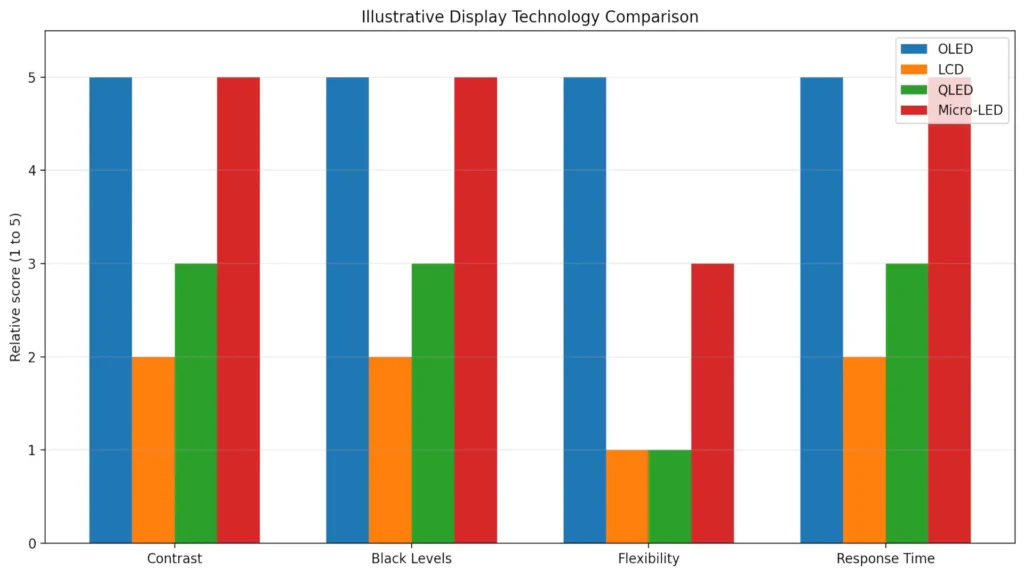
If I had to simplify the buying advice: choose OLED if you care most about black levels, contrast, movie watching, premium gaming, and overall picture depth. Choose a good LCD or QLED if you want lower cost, very high brightness in sunlit rooms, or you are shopping in a more budget-conscious range. For most people, OLED is the better “wow factor” display technology, but it is not automatically the best value for every setup.
Future of OLED Technology
OLED is not standing still. In fact, some of the most exciting work is happening right now.
Foldable devices
Foldable phones and tablets are one of the clearest uses for OLED because the technology can be made flexible. That makes it possible to build displays that bend, fold, or even roll. As hinge design and panel durability improve, foldables are likely to become more practical and more common.
The real promise here is not just novelty. Foldable OLED devices can give people a bigger screen in a smaller pocketable shape. That is a design change with genuine everyday value.
Wearable and implantable devices
OLED is also a strong fit for wearables because it can be thin, light, and conform to surfaces that are not perfectly flat. Smartwatches already benefit from this. Looking further ahead, researchers are exploring stretchable and body-conforming OLED displays for medical devices, smart textiles, skin-mounted electronics, and other tiny interfaces.
That future sounds futuristic, but the research is already real. Recent work has shown highly stretchable OLED designs for adaptable electronics, which suggests that wearable displays may become more capable and more natural to use over time.
Augmented and virtual reality
AR and VR need displays that are sharp, fast, and visually convincing. OLED, especially micro-OLED, is a strong candidate because it can deliver high pixel density and excellent response times in very small display areas.
That matters a lot in near-eye devices where the screen is viewed through lenses at close range. In those products, clarity, latency, and compact size matter more than simply making the screen big. OLED is a natural fit here, which is why it keeps showing up in the conversation about premium headsets and next-generation immersive devices.
Blue PHOLED materials
One of the most important next steps for OLED efficiency is better blue emissive materials. That is where PHOLED comes in. PHOLED refers to phosphorescent OLED materials, which can be much more efficient than fluorescent ones because they can make better use of electrical energy.
The issue has been that blue materials are still especially difficult to optimize. Better blue PHOLED materials could improve efficiency, brightness, and overall panel lifetime. If researchers keep making progress here, future OLED displays could become more power efficient without giving up the rich color and contrast people already love.
That is a big deal. Better blue materials would not just help with battery life. They could also improve image quality and reduce some of the long-term aging problems that have challenged OLED adoption in certain product categories.
A Simple Way to Think About OLED
If LCD is like shining a flashlight through a picture, OLED is more like each tiny pixel being its own tiny lamp. That is the easiest mental model to keep in your head.
Once you understand that, the rest starts to make sense. True black becomes possible because pixels can fully switch off. Contrast improves because dark and bright areas can exist side by side more naturally. Flexibility improves because the display stack is simpler. And the image often feels more alive because the pixels react very quickly.
Why OLED Matters for Screen Resolution Discussions
Since I run a screen resolution website, this is the part I care about most. People often check their display resolution and assume that higher resolution automatically means a better-looking screen. In practice, that is only half the story. Resolution controls how much detail you can see, but panel technology controls how that detail actually looks. That is why a 1080p OLED can sometimes feel more impressive than a higher-resolution LCD in real everyday use.
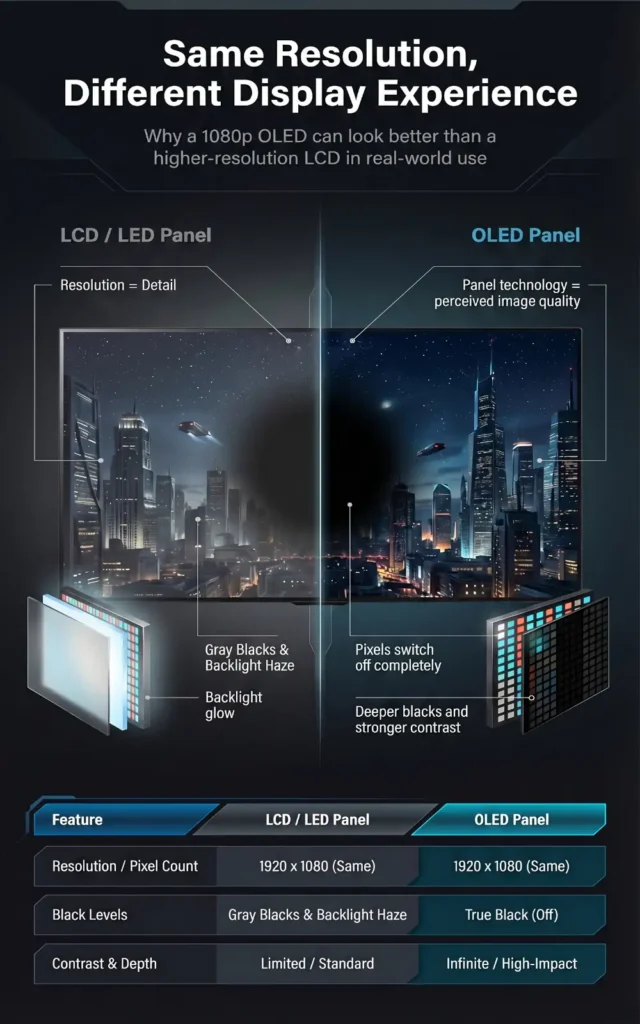
That distinction matters a lot. Resolution controls sharpness and detail. OLED technology controls contrast, color behavior, black levels, and motion feel. Two screens can share the same resolution and still look very different because one uses OLED and the other uses another display technology.
So when people ask whether OLED is “better,” the honest answer is that it is often better for picture quality, but not because it magically adds pixels. It makes the existing pixels look better.
If you want the short version, OLED is usually the best fit for people who care most about movie watching, premium gaming, deep black levels, and a more immersive image. If your priority is maximum brightness in a sunlit room or spending less, a strong LCD or QLED can still make more sense.
Also Read: Wide Color Gamut (WCG): The Hidden Reason Your Screen Looks More Vibrant
Conclusion
OLED is one of the most important display technologies to understand if you care about how a screen actually looks, not just what resolution number is printed on the box. From everything I have tested across phones, laptops, monitors, and TVs, OLED consistently stands out when you want deeper blacks, stronger contrast, faster pixel response, and a more premium image overall.
The biggest takeaway is simple: OLED does not increase resolution by itself, but it can make the same resolution look dramatically better. That is why two 4K displays can feel completely different in real use, and why panel type matters just as much as pixel count when you are comparing screens.
OLED still has trade-offs, including price, burn-in risk, and long-term material challenges. But if picture quality is your priority, it remains one of the best display technologies available today. And if you are trying to understand why your screen looks the way it does, OLED is one of the first technologies worth learning.