Choosing between Full Array LED vs OLED can feel more confusing than it should be. I built whatismyscreenresolution.site because I kept seeing display terms explained in a way that sounded technical but did not actually help people make a confident buying decision.
This is one of those comparisons where specs alone can be misleading. On paper, both can look excellent. In a showroom, both can grab your attention. But in real home use, the better choice depends on where you watch TV, what you watch most, and how much you want to spend.
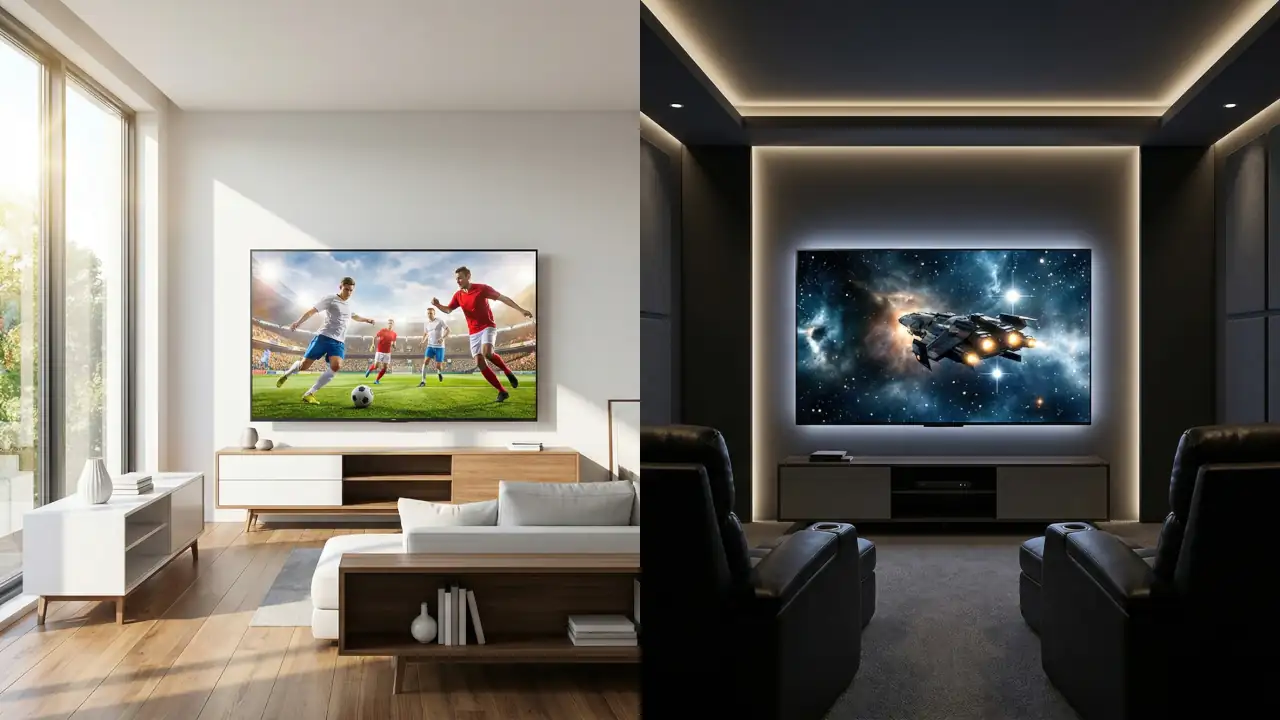
If you usually watch in a bright living room, you may care more about peak brightness and how well the screen fights glare. If you love movies at night, black levels and contrast may matter more. If you game a lot, response time and motion handling become part of the story. And if you keep the same news ticker, sports score, or game HUD on screen for hours, durability starts to matter too.
That is why this comparison matters. Full Array LED and OLED are both excellent, but they solve the TV problem in very different ways. One uses a backlight and smart dimming zones. The other lets every pixel light itself. Those two designs lead to different strengths, and once you understand them, the choice gets much easier. In this guide, I will walk you through the real-world differences in a simple, practical way, so you can decide which display fits your room and your habits instead of just chasing a spec sheet.
Also Read: PHOLED vs OLED: Key Differences, Benefits, and Which Is Better
Quick Answer: Full Array LED vs OLED TV
In a Full Array LED vs OLED TV comparison, OLED usually delivers better picture quality thanks to true blacks, stronger contrast, wider viewing angles, and faster pixel response. Full Array LED is often brighter, more affordable, and better suited for bright rooms or long sessions with static content. If you watch movies in a darker room, OLED usually wins. If you want value and brightness, Full Array LED is often the smarter buy.
Understanding Full Array LED
A Full Array LED TV is still an LCD TV at heart. The screen does not make its own light. Instead, it uses an LED backlight behind the LCD panel, while the LCD layer controls how much of that light gets through. That is the basic idea, but the important part is how the LEDs are arranged.
With Full Array lighting, the LEDs sit across the back of the screen instead of just around the edges. That gives the TV a more even backlight and allows the manufacturer to divide the panel into dimming zones. Those zones can brighten or darken independently, which helps improve contrast. This is one of the biggest reasons Full Array LED looks better than older LED LCD designs.
To understand why this matters, it helps to compare Full Array with edge-lit and simpler direct-lit TVs. Edge-lit screens place the LEDs around the frame, which can make the TV thinner and cheaper, while direct-lit models use a more basic backlight layout with less precise control than Full Array local dimming. Full Array has the advantage because the light source is spread behind the whole panel, not pushed in from the sides.
A Full Array LED TV also works well with local dimming, often called Full Array Local Dimming (FALD), which is the feature that lets certain zones darken when the scene is dark and brighten when the scene is bright. The more zones a TV has, the more controlled the image can look. That is why higher-end Full Array models often look much better than basic LED TVs in movie scenes with deep shadows.
This type of display also pairs nicely with High Dynamic Range (HDR). HDR needs both bright highlights and dark shadows to look convincing. Full Array LED does a solid job here because it can push brightness higher than most OLED TVs. That is a big reason many people still choose Full Array LED for bright rooms.
The catch is that LCD panels still rely on a backlight. So even with local dimming, light can sometimes spill into dark parts of the image. That is why you may hear people mention blooming or haloing around bright objects on dark backgrounds. It is not a dealbreaker for everyone, but it is one of the main limits of the technology.
When I compare TVs side by side, this is usually the first Full Array limitation I notice in dark menus, subtitles, or bright logos on black backgrounds. On a good model, blooming is controlled well enough that most people will not care. On a weaker one, it can be distracting once you know what to look for.
One quick note here: some newer premium TVs use Mini-LED backlights, which are still part of the LED-LCD family but use much smaller LEDs and often far more dimming zones than traditional Full Array sets. That can improve contrast control and reduce blooming, although it still does not fully match OLED’s per-pixel lighting. If you are shopping at the higher end, this is worth keeping in mind because some of the best “Full Array-style” TVs today are really Mini-LED models.
If you are researching premium TV tech, you may also come across terms like QD-OLED or MicroLED. They are separate display categories from a traditional Full Array LED vs OLED comparison, but it helps to know they exist because they often show up in higher-end TV buying guides.
Understanding OLED
OLED stands for Organic Light Emitting Diode. The easiest way to think about it is this: each pixel makes its own light. There is no separate backlight behind the screen. That changes everything.
Because every pixel can turn fully off, OLED can produce true black. Not very dark gray. Not “close enough.” Actual black. That gives OLED its famous contrast advantage. Dark movie scenes look richer, shadow detail tends to feel more natural, and bright objects on black backgrounds can look almost like they are floating in the image.
That self-emissive design also helps with viewing angles. Since the image does not depend on a shared backlight, OLED tends to look consistent even when you move off to the side. Color and contrast usually hold up better than they do on LCD-based TVs.
OLED also has a reputation for great motion performance. The pixels switch very quickly, so fast scenes can look cleaner with less blur. That is one reason gamers and sports fans often love it.
Of course, OLED is not perfect. Brightness is the main tradeoff. Modern OLED TVs are much brighter than older ones, but the brightest Full Array LED sets still usually win in raw peak brightness. There is also the question of burn-in. That risk is much smaller on modern sets than people think, but it is not zero, especially if you display the same static content for long periods.
Still, when people say OLED looks more cinematic, they usually mean the contrast and black levels. That is the heart of OLED’s appeal.
When I see OLED in a dim room, the difference is usually most obvious in dark movie scenes, letterbox bars, and bright highlights against black backgrounds. That is where OLED tends to look the most “premium” in person.
Full Array LED vs OLED: Key Differences
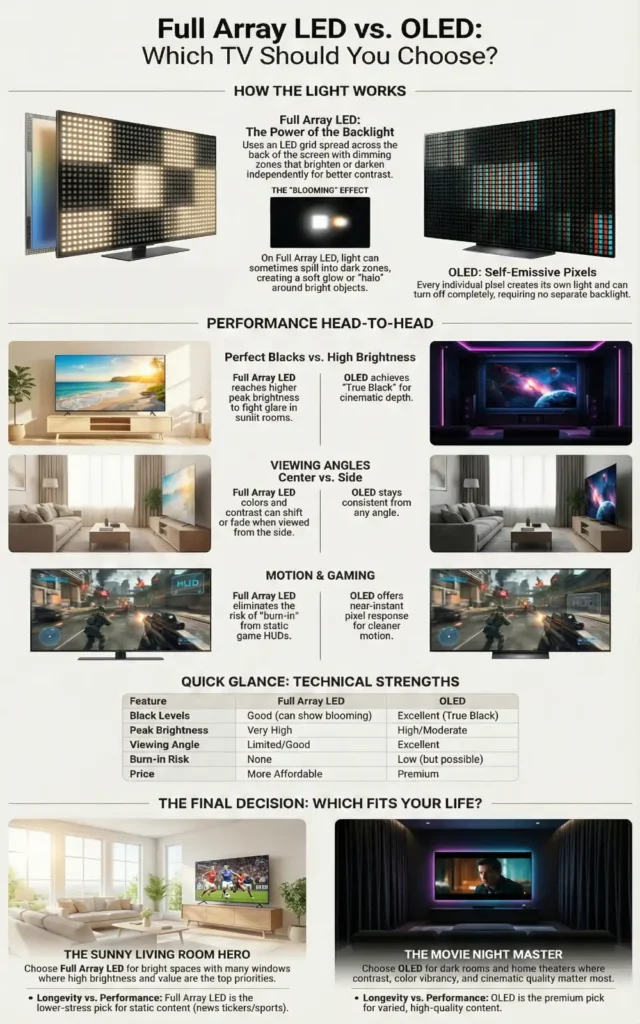
| Feature | Full Array LED | OLED |
| Black levels and contrast | Good, with help from local dimming, but can show blooming | Excellent, with each pixel turning off for true black |
| Brightness | Usually higher peak brightness | Usually lower peak brightness, though still strong on premium models |
| Color vibrancy | Very good, especially high-end models with quantum dots | Excellent, helped by deep blacks and strong contrast |
| Viewing angles | Good, but can shift off-axis | Excellent, with less color and contrast shift |
| Response time and gaming | Fast, but not as instant as OLED | Near-instant pixel response, very good for gaming |
| Burn-in risk | No practical burn-in risk | Some burn-in risk, though modern protections help |
| Price | More affordable overall | Usually more expensive |
| Best use case | Bright rooms, large screens, budget-conscious buyers | Movie watching, darker rooms, premium picture quality |
Black Levels and Contrast
This is usually the first place people notice the difference. OLED wins here, and it wins clearly.
On OLED, individual pixels shut off completely, so dark scenes actually look dark. That gives the display an almost cinematic depth that is hard to miss. Stars in a night sky look sharper. Black bars in movies blend into the screen better. Scenes with candles, headlights, or neon signs can look beautiful because the bright parts stand out so much against the darkness.
Full Array LED has improved a lot, and good local dimming can make it look very convincing. But the backlight is still shared by zones, not pixels. That means a bright object in a dark scene may force a nearby zone to light up a little too much. That is where blooming comes from. It is the soft glow you sometimes see around white text or bright objects on dark backgrounds.
For most everyday TV watching, Full Array LED contrast is more than good enough. But if you care deeply about movie night performance, OLED still feels like the cleaner, more refined display.
In my own testing, this difference is easiest to spot in dark streaming scenes with subtitles, space scenes, or movies with lots of shadow detail. That is where OLED usually looks more controlled and less “lit from behind.”
Brightness Capabilities
This is where Full Array LED usually fights back.
A strong Full Array LED TV can get very bright, which helps a lot in daylight or in rooms with lots of windows. When sunlight hits the screen or lamps are on in the room, extra brightness makes the picture easier to see. It also helps HDR highlights pop more aggressively. Think of reflections on water, sunlight on metal, or explosions in an action film. Full Array LED can make those moments look punchy and bold.
OLED has improved, and newer panels are much brighter than they used to be. Even so, the brightest LED LCD sets still tend to hold the advantage in peak brightness. That does not automatically make them better overall, but it does make them a smart choice for bright viewing environments.
If your TV sits opposite windows or in a room that stays bright during the day, this is one of those differences that matters more in real life than it does in spec sheets. I have seen mid-to-high-end Full Array sets look easier to live with in bright family rooms even when OLED looked better at night.
So the real question is not “which one is brighter?” It is “where will you watch most often?” In a bright room, Full Array LED often has the edge. In a darker room, OLED does not need to be the brightest thing in the room to look fantastic.
Color Accuracy and Vibrancy
Both technologies can look excellent in color, especially on premium models. In real use, factory tuning matters too, so two TVs using different technologies can still look surprisingly different depending on how well the manufacturer handles color accuracy out of the box. The difference is more about presentation than pure capability.
OLED often looks more vibrant because its blacks are so deep. That contrast makes colors feel richer and more defined. Reds look cleaner. Blues look more striking. Small colored details on dark backgrounds stand out beautifully. It is not just about saturation. It is about how the colors sit inside the image.
Full Array LED can also deliver superb color, especially if the TV uses quantum dot technology (often marketed as QLED) and supports wide color gamuts. In the right model, you can get vivid, lively colors that hold up well even at higher brightness levels. That matters a lot for HDR content, where color volume and brightness work together.
The easy way to think about it is this. OLED often feels more natural and dramatic at the same time. Full Array LED can feel brighter and more energetic. Neither is automatically wrong. It depends on the look you prefer.
Viewing Angles
OLED usually wins here too.
If you sit directly in front of your TV, both technologies can look excellent. But if people watch from the side, OLED tends to hold its picture better. Colors stay more stable, and contrast does not fall off as quickly. That makes it a strong choice for wide seating arrangements, family rooms, and spaces where everyone does not sit dead center.
Full Array LED has improved, but it still behaves like most LCD-based screens when viewed off-axis. Part of that also depends on the LCD panel type, since some LED TVs lose contrast faster off-angle than others. As you move to the side, the image can lose some contrast or shift slightly in color. On some sets, it is barely noticeable. On others, it is obvious.
If your couch is centered and your seating is narrow, this may not matter much. But if you often have people watching from different spots in the room, OLED gives you more consistency.
Response Time and Gaming Performance
Gaming is one of the most interesting areas in the Full Array LED vs OLED debate.
OLED has an advantage because its pixels change state very quickly. That means less motion blur, cleaner movement, and a snappier feel in fast-action games. Racing games, shooters, and sports titles all benefit from that quick response. If you have ever seen a TV where fast camera pans look a little smeared, OLED reduces that problem nicely.
Full Array LED is still very capable for gaming. Good models support high refresh rates, low input lag, and solid motion handling. That said, the pixel response is generally not as instant as OLED, so some fast scenes may look a little less sharp.
If gaming is a big part of your decision, this quick visual shows where OLED feels faster and where Full Array LED can be the lower-stress option.
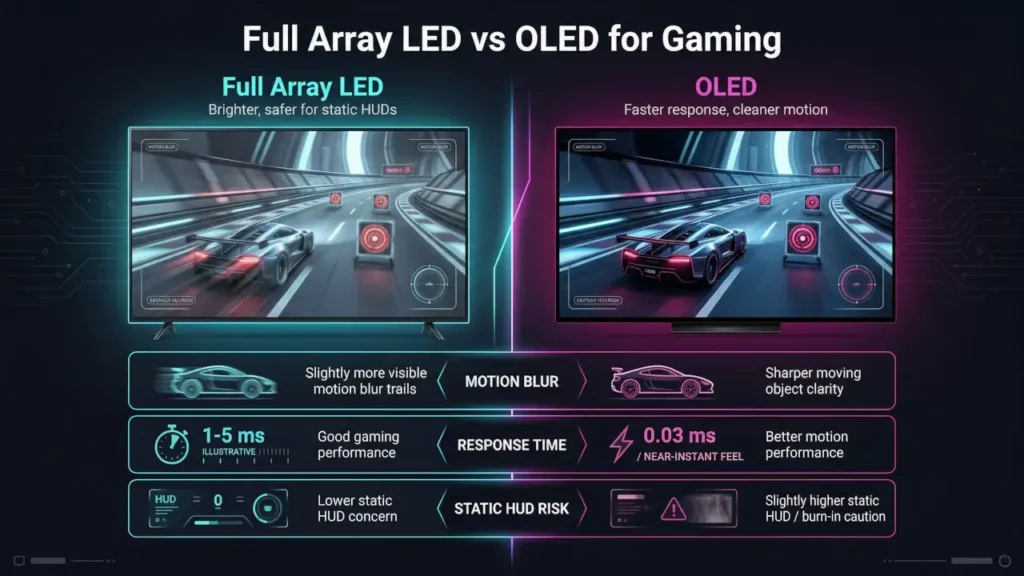
There is another gaming angle to consider. If you play the same game for hours and leave the same UI elements on screen all the time, OLED’s burn-in risk becomes part of the decision.
For many gamers, modern protection features are enough to keep that worry small. For others, especially if the TV also doubles as a monitor, Full Array LED may feel safer. That is especially true if you leave pause menus, mini-maps, scoreboards, or desktop UI elements on screen for long stretches. For mixed gaming and TV use, OLED is excellent. For heavy static-use habits, Full Array LED is the lower-stress option.
Durability and Burn-In Risk
This is the area where Full Array LED has the simpler story.
Because it uses a backlight rather than self-lit pixels, Full Array LED is not subject to the same burn-in concerns as OLED. That makes it appealing for people who watch news channels, sports tickers, or gaming HUDs for long stretches. It also makes it an easier choice for use as a general-purpose screen in a busy home.
OLED is better than its reputation suggests. Modern panels include safeguards like pixel shifting, logo dimming, and screen cleaning features. For normal mixed viewing, that reduces the risk a lot. Still, if you regularly leave static images on screen for many hours every day, OLED asks for a little more care.
In simple terms, Full Array LED is the safer long-term pick for static content. OLED is still a strong option for most people, but it rewards varied content more than repetitive screen use.
Price and Affordability
Price is one of the most practical differences, and it often decides the purchase.
Full Array LED models are usually cheaper than OLED TVs of similar size. That matters if you want a large screen without pushing your budget too far. It also means you can often get a very good TV for less money if you choose a strong Full Array LED model.
OLED usually sits in the premium tier, although pricing has become more competitive than it used to be. It still often costs more than Full Array LED, especially as screen size goes up. That does not mean it is overpriced. It means you are paying for the self-emissive panel, the contrast advantage, and the overall image quality.
So the question becomes simple. Do you want the best picture and are you willing to pay for it? OLED may be worth it. Do you want a very strong TV that gives you more size and brightness for the money? Full Array LED often makes more sense.
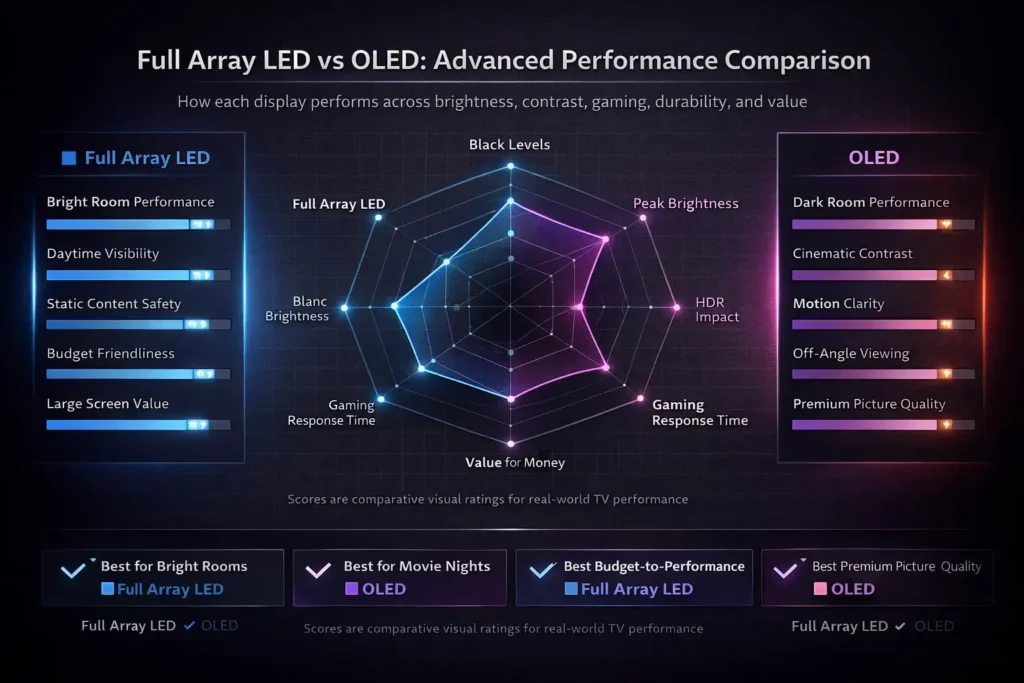
If you want the short version before the buying advice, this visual sums up where each display type tends to perform best in real-world use.
Ideal Use Cases
If your room is bright most of the day, Full Array LED is usually the smarter buy. The extra brightness helps a lot, and the image stays easier to see in rooms with sunlight, lamps, or mixed ambient light. That makes it a good choice for living rooms, open-plan spaces, and daytime viewing.
If you love movies and watch mostly at night, OLED is often the more satisfying display. Black levels, contrast, and viewing angles all come together to create a more premium picture. It feels special in the dark, especially with well-mastered 4K HDR content.
If you are a gamer, both can work well. OLED gives you faster response and less blur. Full Array LED gives you more peace of mind about burn-in and often more brightness for shared living spaces. That makes the better choice depend on how you game, not just how much you game.
If you want the biggest screen for your budget, Full Array LED usually wins. If you want the most impressive picture quality in a controlled room, OLED usually wins.
Full Array LED vs OLED for Different Buyers
If you want the fastest answer, here is how I would break it down:
- Best for bright rooms: Full Array LED
- Best for movie nights in a dark room: OLED
- Best for gaming performance: OLED
- Best for lower burn-in risk: Full Array LED
- Best for value at larger sizes: Full Array LED
- Best for the most premium picture quality: OLED
If someone asked me for the simplest buying advice, I would say this: choose Full Array LED for brightness and value, and choose OLED for the best overall picture quality.
If budget were the deciding factor, I would usually recommend a strong mid-to-high-end Full Array LED first. If picture quality were the only goal and the budget allowed it, I would usually lean OLED.
A Simple Way to Decide
Here is the easiest way to think about it.
| Choose Full Array LED if you | Choose OLED if you |
| Watch in a bright or sunlit room | Want the best black levels and contrast |
| Want higher peak brightness for HDR highlights | Mostly watch movies or shows in a darker room |
| Want better value at larger screen sizes | Care about wide viewing angles |
| Prefer a lower-risk option for static content like news tickers or gaming HUDs | Want cleaner motion and faster pixel response for gaming |
That is really the heart of the Full Array LED vs OLED decision. It is not about which one is universally better. It is about which one fits your life better.
Also Read: OLED Technology Explained: How OLED Displays Improve Picture Quality
How I’d Personally Choose Between Full Array LED and OLED
If I were buying for a bright living room, I would usually choose a strong Full Array LED TV first, especially if I wanted a bigger screen without overspending. If I were building a movie-first setup for nighttime viewing, I would pick OLED almost every time. That is the simplest honest answer: Full Array LED is often the practical choice, while OLED is usually the premium picture-quality choice.
Final Thoughts
After comparing OLED vs Full Array LED side by side, the answer is pretty clear. OLED usually delivers the better picture quality in terms of contrast, black levels, and viewing angles. It looks more refined, especially for movies and shows in a darker room. Full Array LED, though, has its own strengths. It is brighter, often cheaper, and less stressful for people who watch a lot of static content. In a bright room, it can be the better experience overall.
That is why there is no one-size-fits-all winner. If someone asks me for the best picture quality in a darker room, I usually point them toward OLED first. If they tell me the TV is going into a bright living room, they want more screen for the money, or they watch a lot of static content, I usually lean toward a good Full Array LED model. The best TV is not the one with the flashiest spec sheet. It is the one that fits your room, your habits, and your budget.
Bottom Line
If you want the best overall picture quality, OLED is usually the better TV. If you want a brighter, more affordable, and lower-risk option for bright rooms or static-heavy use, Full Array LED is often the smarter buy.