I spend a lot of time testing display behavior on phones, monitors, and TVs while running whatismyscreenresolution.site, and one thing I’ve noticed over the past few years is that OLED screens keep getting brighter and more power efficient at the same time. That sounds simple on paper, but it’s actually a huge engineering challenge — especially when it comes to blue light.
Blue PHOLED is one of those technologies most people will never see listed on a product box, yet it could quietly change how future screens perform. If you’ve ever noticed your phone battery draining faster at high brightness, or felt an OLED device getting warm during HDR video playback, the blue subpixel is part of that story.
After digging through recent display-industry research and watching how manufacturers are approaching OLED efficiency, it’s clear why blue PHOLED is getting so much attention. It has the potential to improve battery life, reduce heat, and help OLED panels push higher brightness without the same power penalties current panels face.
And unlike a lot of futuristic display concepts that stay stuck in labs for years, this one is already moving toward commercial production.
Also Read: 4K Resolution: The Hidden Reason Your Screen Looks Stunning
Quick Answer: Blue PHOLED Explained
Blue PHOLED is a next-generation OLED technology that uses phosphorescent blue emitters to improve display efficiency, reduce power consumption, and increase brightness. It could help future phones, TVs, wearables, and AR devices deliver better battery life and lower heat output compared to current OLED panels.
What Is PHOLED?
PHOLED stands for phosphorescent organic light-emitting diode. In plain English, it is an OLED design that uses phosphorescent emitters to turn electricity into light more efficiently than older fluorescent emitters. The important thing to know is that PHOLED is not a totally separate family of displays. It is part of the OLED world. The difference is in the material used to create the light.
Normal OLED panels are self-emissive, which means each pixel makes its own light instead of depending on a backlight. That is one of the reasons OLED screens look so good. They can turn individual pixels off completely, so blacks look truly black and contrast looks strong. You can read more about the basics of OLED technology if you want the foundation before going further.
In a PHOLED, the emitter can make much better use of the electrical energy going into it. That is the main reason display engineers care so much about blue PHOLED. It is not just about color. It is about efficiency, heat, lifespan, brightness, and how a whole panel behaves under real-world use.
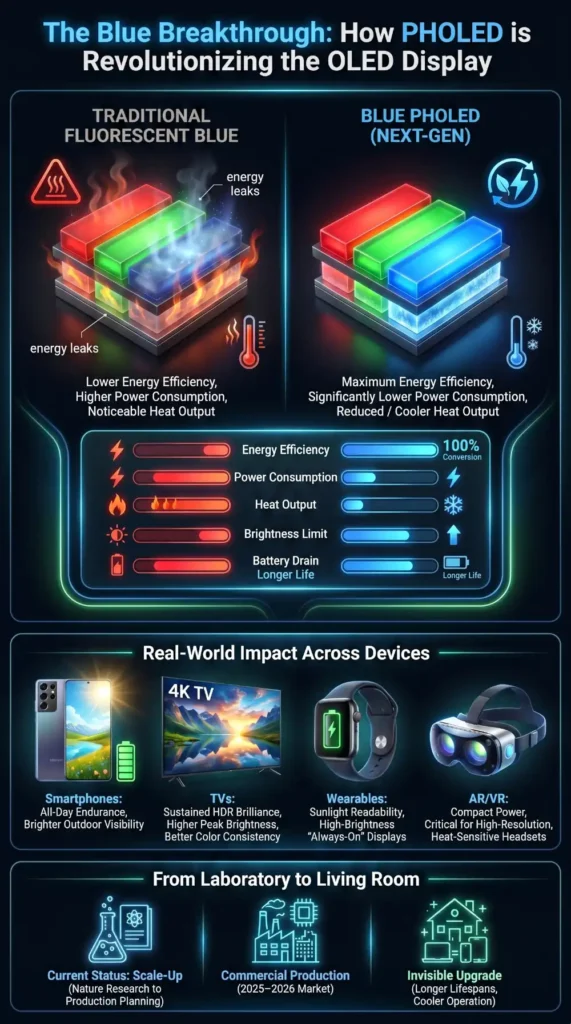
Today’s OLED panels already use phosphorescent materials for red and green pixels, but blue has remained the difficult part of the stack because fluorescent blue consumes more power and degrades faster over time. IEEE Spectrum recently highlighted how replacing fluorescent blue could significantly improve OLED efficiency and panel balance within existing OLED display architectures.
PHOLED vs Traditional OLED
Traditional fluorescent OLED materials only convert a portion of electrical energy into visible light efficiently, while phosphorescent OLED materials can use energy much more effectively. That is why PHOLED technology is viewed as one of the biggest long-term efficiency upgrades for OLED displays.
Why Blue Matters So Much
Blue sounds like just another color, but in display engineering it is the color that causes the most trouble. Blue light carries more energy than red or green light, and that makes it harder to keep stable over time. The result has been a long-running compromise: OLED makers have had to accept a less efficient blue subpixel in exchange for acceptable lifetime and image quality. That trade-off affects phones, TVs, and wearables alike.
This is where blue PHOLED becomes exciting. It promises a more even RGB balance, which can help displays look brighter without always needing to pour in more power. In practical terms, improving blue OLED efficiency could translate into longer battery life, brighter displays, or reduced power consumption depending on how manufacturers decide to tune their panels.
Advantages of PHOLED
The biggest advantage of PHOLED is simple: it makes better use of energy. That means less waste, less heat, and potentially longer-lasting screens. In a phone, that can translate into better battery life. In a TV, it can mean higher brightness or lower power draw. In a wearable, it can help keep the screen readable without draining a tiny battery too quickly.
There is also a visual upside. Because PHOLED materials can support a more balanced subpixel structure, display makers can tune their designs more flexibly. That can help with resolution, brightness management, and panel efficiency. When people talk about the future of OLED panels, they are often talking about small changes like this that add up in a big way.
Another important benefit is heat control. A display that uses less current tends to run cooler, and cooler devices usually age more gracefully.
The broader OLED picture is also worth remembering. OLED displays are already known for strong contrast, fast response times, thin designs, and the ability to work in flexible or foldable products. Blue PHOLED builds on that advantage instead of replacing it.
More efficient blue emitters could also help OLED panels maintain stronger color consistency at high brightness levels, especially during HDR content where color accuracy and luminance need to stay balanced together.
One thing I’ve personally noticed while testing OLED phones at high brightness is how aggressively some devices dim themselves during gaming or HDR playback once heat builds up. More efficient blue emitters could help reduce that thermal pressure. Most users may never think about the blue subpixel directly, but they absolutely notice when a screen stays bright longer without getting hot or draining battery as quickly.
To understand why display manufacturers are investing so heavily in blue PHOLED research, it helps to compare how current blue OLED emitters behave versus what phosphorescent blue emitters are expected to improve.
How Blue PHOLED Compares to Current OLED Blue Emitters
| Feature | Current OLED Blue Emitters | Blue PHOLED |
| Efficiency | Lower | Higher |
| Power Consumption | Higher | Lower |
| Heat Generation | More noticeable | Reduced |
| Brightness Potential | Limited | Improved |
| Battery Impact | Higher drain | Better efficiency |
| Long-Term Goal | Acceptable balance | Optimized balance |
Challenges in Developing Blue PHOLED
This is also why display manufacturers have spent years trying to solve blue OLED efficiency without sacrificing lifespan. The challenge has never been making blue light itself — it’s making it stable enough for real-world consumer devices that run for thousands of hours.
The first problem is stability. Blue photons are more energetic, which puts more stress on the organic materials inside the panel. Over time, that stress can shorten lifespan. Blue OLED materials degrade faster because high-energy blue emission places more stress on the organic compounds inside the panel. That makes long-term stability much harder to achieve compared to red or green OLED emitters.
The second problem is efficiency roll-off. A panel might look great at one brightness level and then lose performance when pushed harder. That matters because phones, TVs, watches, and AR displays do not live in a lab. They are used in sunlight, in dark rooms, during gaming, while streaming, and while changing brightness constantly.
The final challenge is manufacturing at scale. A display technology does not become commercially important until companies can produce it consistently, efficiently, and at high volume. Recent industry progress suggests blue PHOLED is moving beyond laboratory testing and closer to real-world consumer products.
That is not the same thing as saying every device now uses it, but it is a strong signal that blue PHOLED is moving from research into real production planning.
Applications of PHOLED
Blue PHOLED could have the biggest impact in the same categories where OLED displays are already widely used today. OLED displays are already common across phones, TVs, tablets, monitors, laptops, and wearables, which is why improvements to blue OLED efficiency could affect almost every major screen category. Blue PHOLED can improve all of those categories, but in slightly different ways.
Phones
On phones, the appeal is battery life and brightness. Most smartphone displays use red, green, and blue subpixels directly. If the blue subpixel becomes more efficient, the whole screen becomes easier to drive. That could mean better all-day use, less heat, and more headroom for higher refresh rates or brighter HDR modes.
Because OLED panels are already used in foldable phones and flexible display designs, improvements to blue OLED efficiency could also benefit future foldable and rollable devices where thermal management and battery efficiency are especially important.
TVs
On TVs, the story is different. TV makers often chase brightness, color volume, and manufacturing efficiency. LG and Samsung use different OLED stack approaches, but both stand to gain from a better blue emitter. Improvements to blue OLED efficiency could also indirectly benefit display architectures like QD-OLED, which rely heavily on blue OLED light sources underneath quantum dot layers. That matters because a better blue layer can improve both image quality and cost structure.
Wearables
Wearables may be the quiet winner. Smartwatches and similar devices have tiny batteries, tiny panels, and strict thermal limits. Every drop in power use helps. A more efficient blue OLED can make a watch easier to read in sunlight without burning through charge too quickly. That is a small change with a big day-to-day effect.
AR and VR
There is also a growing case for AR and VR. Stable and efficient blue phosphorescent OLEDs are especially important for AR and VR devices, where displays need to maintain very high brightness and resolution inside compact headsets. If you have ever used a headset in a bright room, you already know why that matters.
Blue PHOLED and Screen Quality
This is where a lot of readers get confused, so let’s keep it simple. Blue PHOLED does not automatically mean a screen has a higher resolution. Resolution still refers to how many pixels the screen contains. But it can make a screen easier to build in a way that supports sharper, brighter, and more balanced output.
That is a useful distinction. A 4K panel and a 1080p panel are still different resolutions. Blue PHOLED is about the underlying light source and how efficiently the panel produces color. In practice, that can make the viewing experience feel cleaner and more capable, especially when the display is pushed hard.
This is also why Blue PHOLED matters to your site’s audience. People who search for screen sizes, pixel density, and display resolution often care about more than numbers on a spec sheet. They care about what those numbers look like in real life. Blue PHOLED is part of that real-life picture because it affects brightness headroom, power use, and how well a display holds up over time.
Where Blue PHOLED Stands Right Now
The biggest reason this topic is getting more attention in 2025 and 2026 is that the research is no longer theoretical. New lab results are showing stronger brightness, better efficiency, and longer operational lifespan than earlier blue phosphorescent OLED designs.
Recent peer-reviewed OLED research published in Nature has shown major improvements in blue phosphorescent OLED brightness, efficiency, and operational lifetime — one of the clearest signs yet that the technology is moving closer to practical commercial use rather than remaining purely experimental.
Those numbers are not everyday consumer specs, but they show why the field is moving forward.
Practical Impact for Buyers
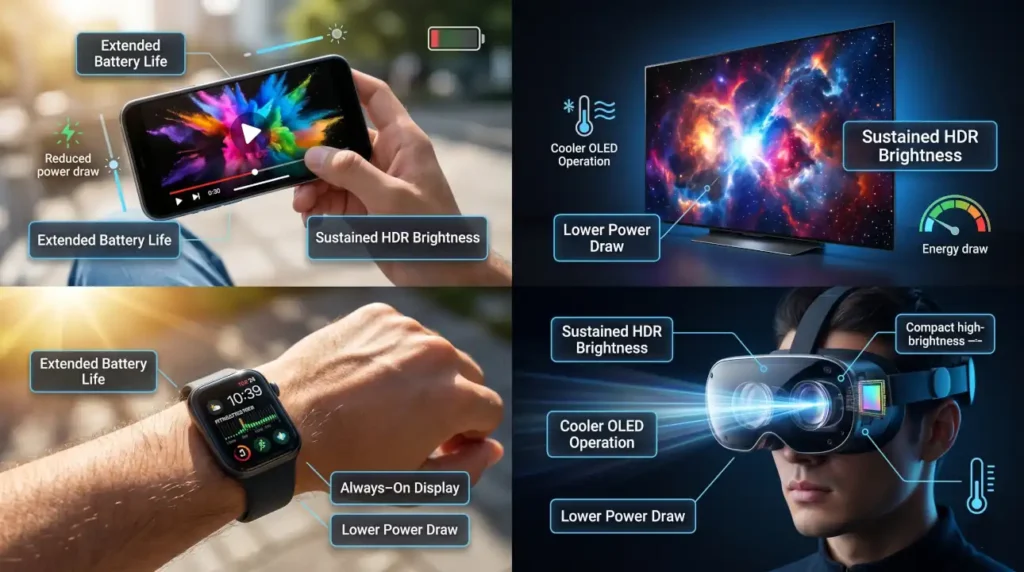
For regular buyers, the short version is this: you may not see “Blue PHOLED” printed on the box right away, but you could feel its effects in the next generation of displays. A phone may last a bit longer. A TV may get brighter without needing as much power. A watch may stay readable with less drain. The user experience improves quietly, which is often how the best display upgrades happen.
If your readers are trying to understand whether a display is good, they still need to look at the usual things: resolution, panel size, brightness, refresh rate, and color quality. Blue PHOLED does not replace those factors. It strengthens the panel underneath them.
What Buyers Should Expect from Blue PHOLED Displays
Blue PHOLED will probably appear gradually rather than all at once. Early improvements may show up as better battery life, less aggressive screen dimming, improved HDR brightness, or cooler device temperatures rather than dramatic visual changes overnight.
Also Read: HDR True Black 400, 500, 600 Could Make Your Screen Look Completely Different
For most buyers, the biggest difference will likely be efficiency. Phones may last longer during video playback, OLED TVs may sustain brightness more effectively, and wearables could become easier to read outdoors without draining battery as quickly.
Conclusion
Blue PHOLED matters because it addresses one of OLED’s longest-running technical weaknesses without changing the things people already love about OLED displays. Better efficiency, lower heat output, improved brightness headroom, and potentially longer battery life all translate into real user benefits.
From what I’ve seen covering display technology, the biggest upgrades are often the invisible ones happening underneath the panel rather than flashy spec-sheet changes. Blue PHOLED feels like that kind of advancement. Most buyers may never know the term itself, but they’ll notice the results when future phones, TVs, and wearables become brighter, cooler, and easier on battery life.