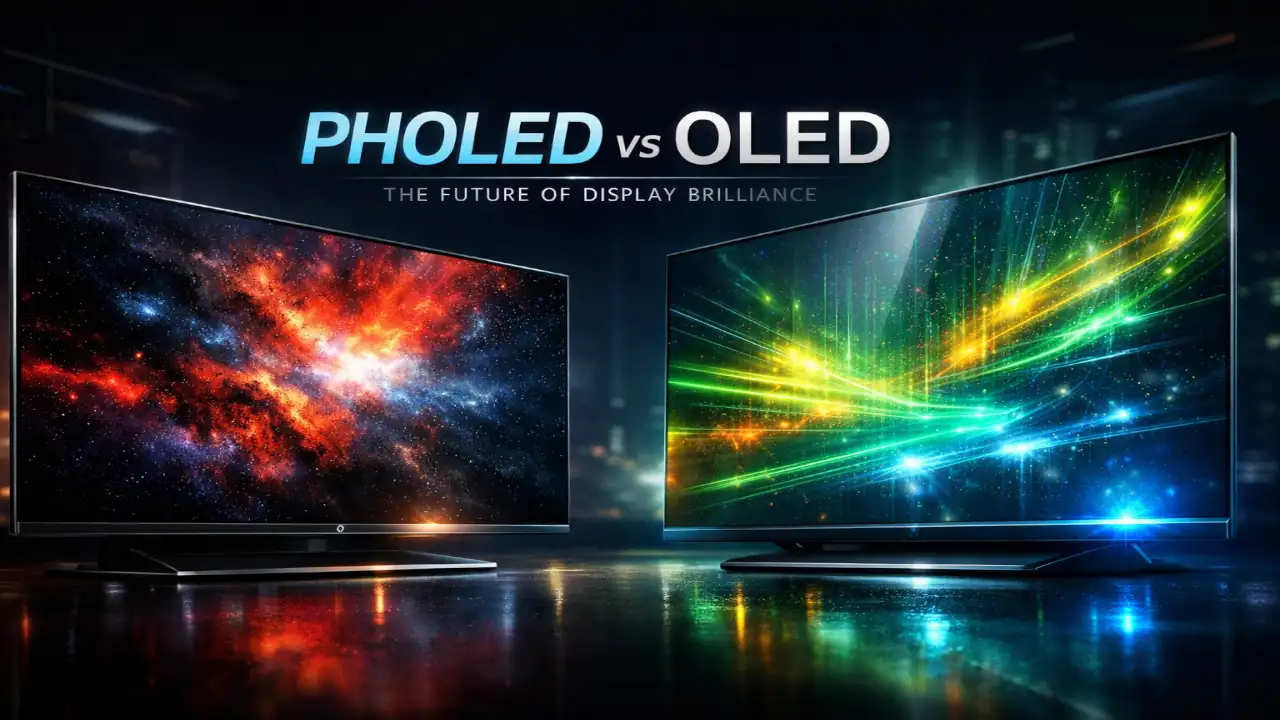
When I see people search for PHOLED vs OLED, they’re usually not looking for lab jargon — they want to know which screen is actually better to buy. I run whatismyscreenresolution.site, and while most visitors come for resolution checks or display tools, I spend a lot of time looking at how screens behave in real-world use too: brightness, black levels, battery drain, and how comfortable a panel feels during long sessions.
In simple terms, when comparing OLED vs PHOLED, OLED is the proven display technology already used in premium phones, TVs, and monitors, while PHOLED is a more advanced OLED approach designed to improve efficiency and brightness. The catch is that blue PHOLED materials are still harder to perfect, which is why OLED is the practical winner today and PHOLED is still the more exciting future-facing technology.
Also Read: UWQHD vs 4K: Which Monitor Resolution Is Better for Gaming, Work, and Everyday Use?
Quick Answer: PHOLED vs OLED
PHOLED is a more advanced type of OLED that uses phosphorescent emitters to improve power efficiency and brightness. OLED is still the better choice for most buyers today because it’s mature and widely available, while PHOLED is the more promising future-facing technology but remains limited by the long-standing challenge of stable blue emitters.
What is OLED?
OLED stands for Organic Light-Emitting Diode. It is a display technology that uses organic, carbon-based materials to produce light when electricity passes through them. Unlike LCD panels, OLED screens do not need a backlight behind the display. Each pixel lights up on its own, which is a big reason OLED can produce deep blacks and strong contrast.
When a pixel needs to show black, it can simply turn off. That’s what gives OLED screens their rich look, especially in dark rooms and during high-contrast video. OLED panels are also thin, which is why they are used in sleek phones, curved TVs, foldable devices, and lightweight screens. If you want a deeper breakdown of how self-emissive panels work, I’ve also put together a full guide on OLED technology.
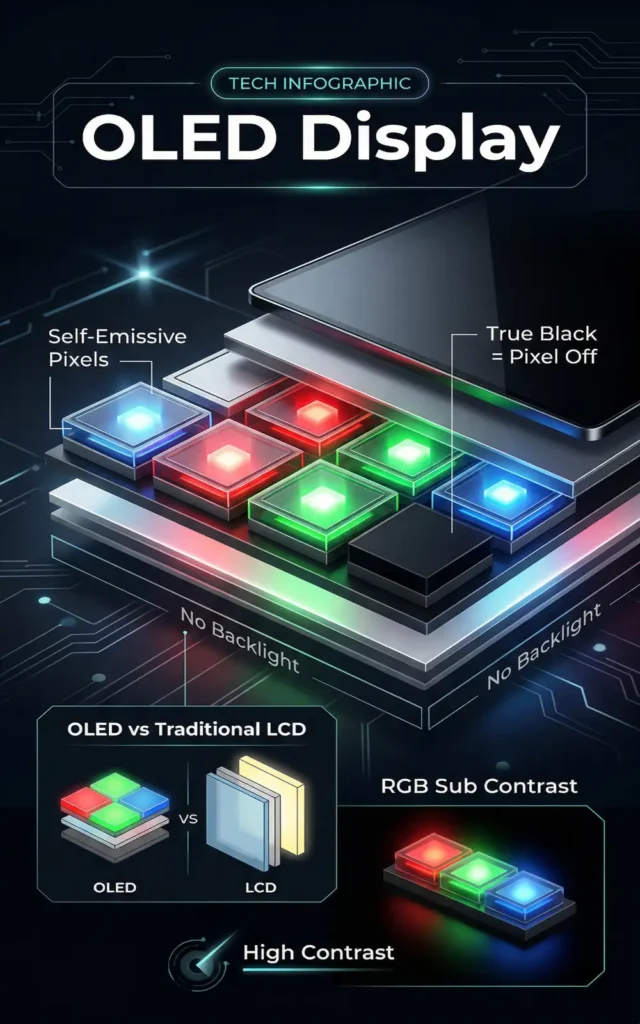
One thing people often miss is that OLED is not just about “better colors.” It is also about how the display makes light in the first place. Because the pixels are self-emissive, OLED can look more uniform and more natural than older panel types that rely on a backlight. That is why OLED became such a big deal for TVs and premium devices.
It also helps explain why OLED is so popular for TVs, premium phones, and gaming displays: you get perfect blacks, near-infinite perceived contrast, wide viewing angles, and extremely fast response times. That combination gives OLED its clean, premium look without needing bulky backlight layers behind the panel. That fast pixel response also helps reduce motion blur, which is one reason OLED panels are so appealing for fast-moving video and gaming.
What is PHOLED?
PHOLED means Phosphorescent Organic Light-Emitting Diode. It is still part of the OLED family, but it uses phosphorescent emitters instead of the older fluorescent approach. The whole point is to get more useful light out of the energy the panel receives.
In practice, that means better efficiency, stronger brightness potential, and less wasted energy. At a technical level, phosphorescent OLED materials can convert far more of the input energy into visible light than older fluorescent OLED approaches, which is why PHOLED is often associated with much higher internal quantum efficiency. The short version is that phosphorescent materials make better use of excitons inside the emissive layer, so they can produce more visible light from the same electrical input.
That is why PHOLED gets so much attention in display research. A strong example is this Nature Communications study on phosphorescent OLEDs, which highlights their low power consumption, high brightness potential, and the ongoing challenge of blue emitter lifetime.
It’s also worth noting that PHOLED is not purely theoretical. Red and green phosphorescent emitters are already part of real commercial OLED progress. The biggest remaining hurdle is blue, which is still the hardest color to make efficient and stable over time.
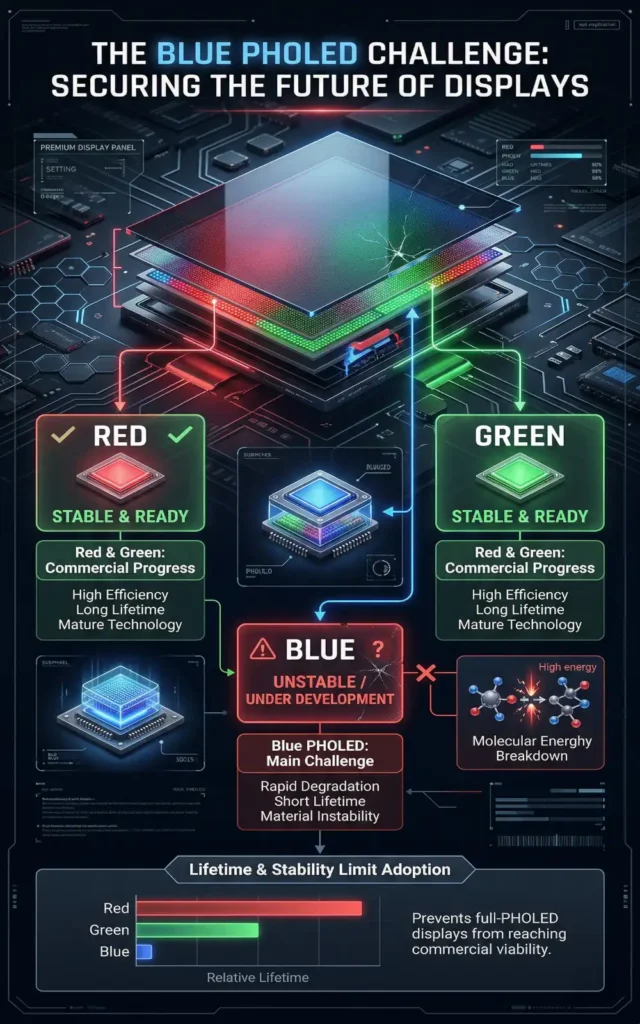
The part that makes PHOLED exciting is also the part that makes it tricky. Blue emitters are still the hardest to stabilize. Green and red phosphorescent OLED materials have seen much stronger real-world progress, but blue PHOLEDs continue to be the problem area.
That matters because blue is essential for accurate full-color displays. If blue is weak, unstable, or short-lived, the whole panel feels the pressure. That’s why so much of the display industry’s attention is on blue PHOLEDs — they’re the missing piece that could make phosphorescent OLED technology far more practical in mainstream consumer devices.
PHOLED vs OLED: The Real Differences
If you’re specifically looking for the main PHOLED vs OLED differences, the biggest ones come down to efficiency, brightness potential, heat, and long-term blue emitter stability.
The simplest way I explain it is this: OLED is the broad display family you can already buy today, while PHOLED is a more efficient emissive approach within that family that still needs material improvements before it becomes mainstream.
Energy Efficiency
This is where PHOLED gets a lot of attention. Standard OLED panels already do a good job because they do not waste power on a backlight. But PHOLED tries to go further by using phosphorescent materials that make better use of the energy in the emissive layer. In everyday terms, that can mean the screen needs less power to reach the same brightness, or it can get brighter without demanding as much from the device. That is a real advantage for phones, wearables, and any screen where battery life matters.
For a buyer, this difference matters most when the screen is being used heavily. Bright screens drain batteries faster. If a display technology can be more efficient at the pixel level, the device can either last longer on a charge or push more brightness without feeling as wasteful. That is one reason PHOLED keeps showing up in the “future of displays” conversation instead of disappearing into a lab note.
Brightness and Heat
Brightness and heat are connected. When a display wastes less energy, it usually generates less unwanted heat. That is important because heat is one of the things that can stress display materials over time. PHOLED’s appeal is that it can deliver stronger brightness performance with better efficiency, which is a nice combination for displays that need to look good in bright rooms or under tough viewing conditions.
OLED panels already look great, but brightness is always a balancing act. Push too hard and you can affect power use, thermal behavior, and long-term stability. PHOLED is interesting because it promises a better balance between output and efficiency. That does not mean every PHOLED panel automatically beats every OLED panel in real life. Implementation still matters. Panel design, thermal management, and materials all matter too. But the direction is clear. PHOLED is trying to make the same kind of beautiful display less costly to run.
Color Accuracy and Stability
OLED is already known for strong color quality, and that is one reason people love it in TVs and premium phones. PHOLED can also deliver excellent color, but the stability question is more complicated, especially when blue is involved. Blue PHOLEDs have been much harder to commercialize because the lifetime problem is still not fully solved. In practical terms, that means the blue portion of the panel is where the biggest trade-offs appear.
This is why color stability is not just about how pretty the screen looks on day one. It is about how well the colors stay consistent after long use. A display can look excellent in a showroom and still face material stress after months or years of real usage. PHOLED is promising, but blue stability is the part that keeps engineers busy. That’s why the honest takeaway is simple: PHOLED has real advantages, but the blue emitter challenge still shapes how practical the technology is today.
Lifespan
Lifespan is where the conversation gets really interesting. OLED screens have improved a lot over time, and modern panels are much better than early versions. Still, different organic materials age differently, and blue has remained the most difficult color to manage. In practical terms, blue PHOLED materials still tend to have much shorter usable lifespans than red and green ones, which is one of the biggest reasons commercialization remains limited. That does not mean the technology is a dead end. It means the hardest part is still being engineered.
For users, lifespan matters because it affects how long the display keeps its brightness, color balance, and overall quality. The best panel is not just the one that looks amazing on day one. It is the one that still looks good after heavy daily use. PHOLED has the potential to improve this area because better efficiency often reduces stress, but the blue emitter problem means the story is not finished yet.
Comparison: PHOLED vs OLED
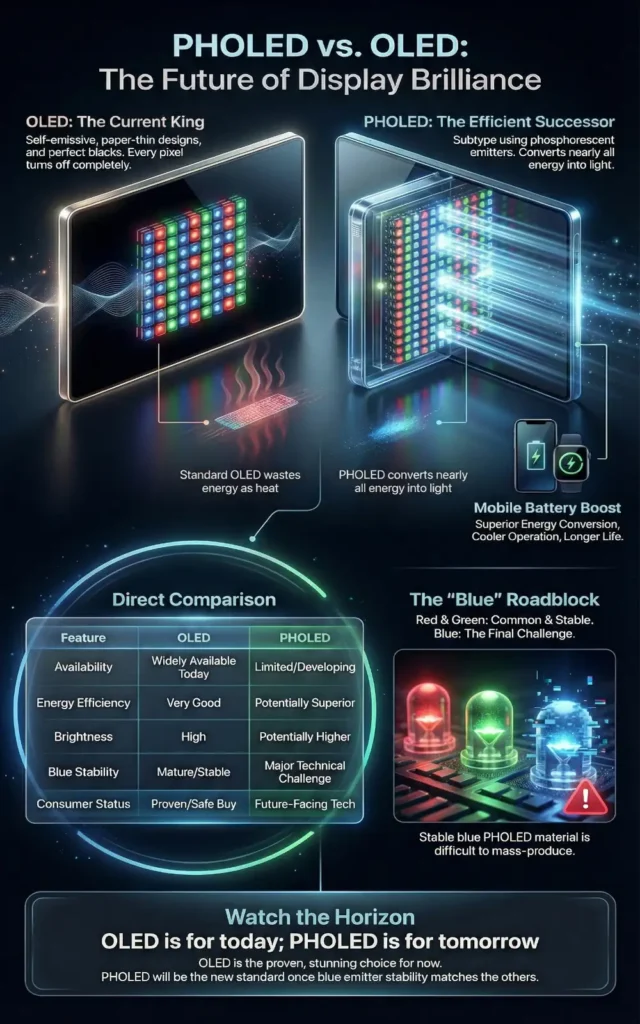
| Feature | OLED | PHOLED |
| Commercial availability | Widely available | Limited / still developing |
| Black levels | Excellent | Excellent |
| Contrast | Excellent | Excellent |
| Power efficiency | Very good | Potentially better |
| Brightness potential | High | Potentially higher |
| Blue emitter stability | Improved but still sensitive | Major challenge |
| Lifespan maturity | Proven in consumer devices | Still evolving |
| Best for today | Yes | Not yet for most buyers |
| Future potential | Strong | Very strong |
If you want a quick visual summary before deciding which technology makes more sense for you, this side-by-side infographic makes the trade-offs easier to understand.
Which One Is Better in Practice?
If you are asking which one is better today for a normal buyer, OLED is the safe and proven choice. It is already mature, widely used, and easy to find in high-quality devices. It gives strong blacks, excellent contrast, thin panel designs, and a very polished viewing experience. That is why OLED has become the default premium display technology in so many products.
If you are asking which technology looks more exciting for the future, PHOLED has the stronger long-term upside. It is built around better efficiency and brighter output, and that makes it a big deal for devices that need to balance image quality with battery life and thermal control. The catch is still blue. Once the blue emitter problem is solved at a commercial level, PHOLED could become a much bigger deal across the display world.
In my own testing, OLED still feels like the more realistic recommendation for most buyers because it’s already polished in actual products. On phones and TVs, the difference most people notice first is not “PHOLED science” — it’s whether blacks look truly deep, whether the screen stays comfortable at high brightness, and whether battery drain gets aggressive during bright HDR content. Right now, OLED wins because it already delivers that experience consistently.
For example, if you’re choosing between a premium OLED phone today and waiting for future PHOLED improvements, OLED is still the smarter buy. You’ll get the deep blacks, excellent contrast, and polished performance now, while PHOLED remains more important as a technology trend than a buying category most shoppers can act on yet.
The honest takeaway is simple: OLED is the better choice for most people right now. PHOLED is the more interesting development path for the next generation of displays. One is already proven. The other is still pushing to become truly mainstream.
Current Applications and Future Prospects
OLED is already deeply established in smartphones, TVs, monitors, and wearables. It is also popular wherever thin design, fast response, low glare, and strong contrast matter. The U.S. Department of Energy’s overview of OLED basics is a good reference here because it explains why OLEDs are thin, self-emissive, and useful across a wide range of display and lighting applications.
PHOLED is better understood as the next stage of OLED efficiency than as a completely separate product category you can shop for today. In practical terms, the biggest future opportunity is in devices where brightness, battery life, and heat matter at the same time — especially phones, wearables, automotive displays, and other premium panels where every bit of power efficiency counts.
A true mainstream PHOLED display will become much more realistic once blue emitter stability improves enough for broader consumer use.
Also Read: Full Array LED vs OLED: Which TV Display Is Actually Better?
My Recommendation
If you’re buying a phone, TV, or monitor right now, I’d choose OLED without hesitation. It’s proven, widely available, and already delivers the deep blacks, strong contrast, and premium look most people actually notice in daily use. If you’re making a real purchase today, OLED is the safer and smarter choice. I’d treat PHOLED as the more exciting technology to watch, especially if you care about future gains in efficiency and brightness.
Conclusion
PHOLED vs OLED sounds like a simple comparison, but it is really a comparison between today’s mature display technology and tomorrow’s more efficient version of it. OLED is already the practical winner for most buyers because it is proven, widely available, and excellent at delivering deep blacks and strong contrast. PHOLED is promising because it can push efficiency and brightness further, which matters a lot for battery life and future display design.
The part to remember is that PHOLED is not “OLED, but with a different name.” It is an advanced phosphorescent approach that tries to improve how organic displays work. That’s why display engineers and panel makers still watch PHOLED development closely.
If the blue emitter challenge keeps improving, PHOLED could become a much bigger player. For now, OLED remains the technology you will actually see in most premium devices, while PHOLED is the direction many engineers want to take next. If you want the best display you can actually buy today, OLED is still the clear winner — but if you want to understand where premium screen technology is heading next, PHOLED is the name worth watching.